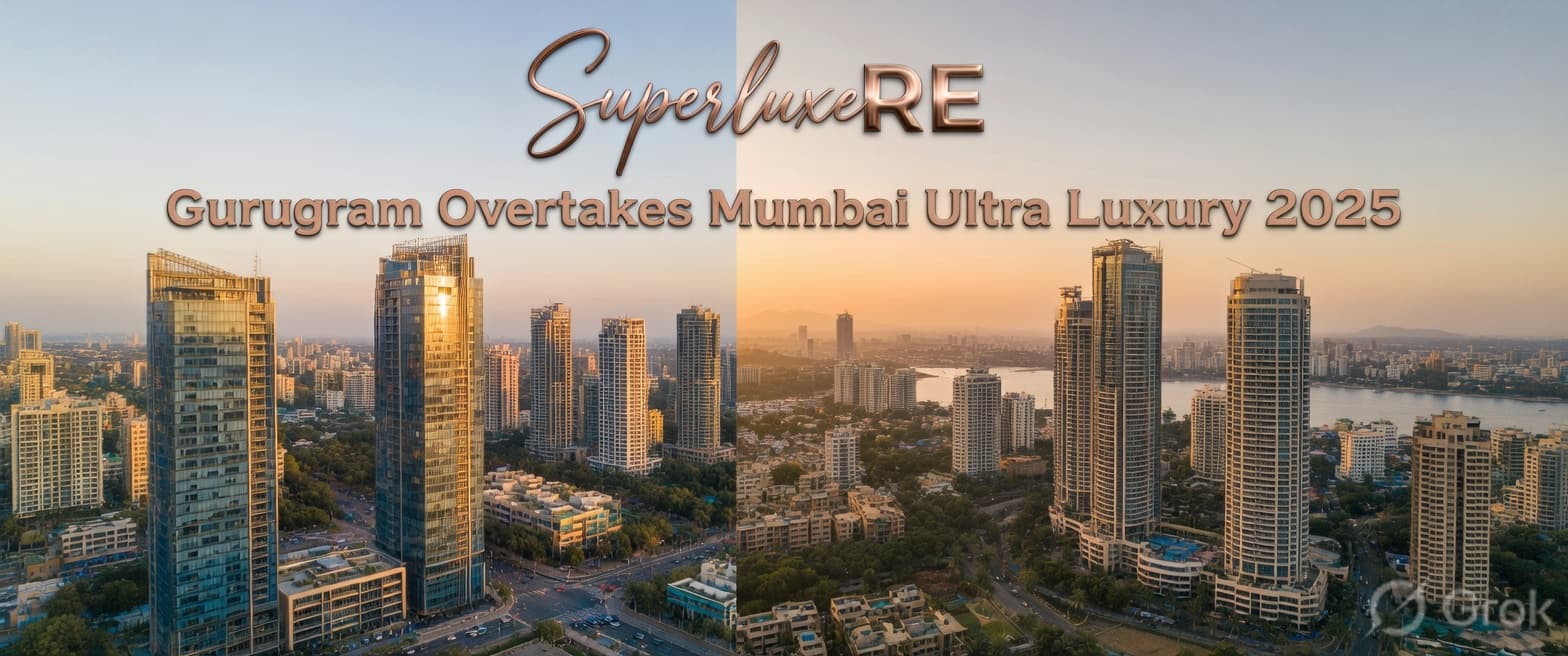
Gurugram recorded ₹24,120 crore in ultra-luxury home sales (₹10 cr+) in 2025, surpassing Mumbai's ₹21,902 crore. Dwarka Expressway surges 2,079%. Analysis by SuperLuxeRE.

Written by
Himanshu Bamola
Founder & Principal Analyst, SuperLuxeRE · 16+ years in ultra-luxury real estate strategy
Himanshu advises HNIs, NRIs, and family offices on India's most complex luxury real estate decisions — from Golf Course Road to Worli. His market analysis is trusted by buyers across Singapore, Dubai, London, and the US.
In a historic shift that marks the coming of age of India's National Capital Region, Gurugram has officially overtaken Mumbai as the country's largest ultra-luxury residential market by transaction value.
According to the landmark India Sotheby's International Realty (ISIR) and CRE Matrix 2025 Luxury Housing Report, Gurugram recorded ₹24,120 crore worth of ultra-luxury transactions (homes priced ₹10 crore and above) in calendar year 2025—surpassing Mumbai's ₹21,902 crore for the first time in modern Indian real estate history.
But the headline numbers only scratch the surface. The real story is where this growth is coming from, who is buying, and what it signals about the future of Indian wealth creation and residential preferences.
📊 The Numbers That Rewrote the Playbook
City-Wise Ultra-Luxury Sales (₹10 Cr+ Segment, CY2025)
| Rank | City | Transaction Value | Key Corridors |
|---|---|---|---|
| 1 | Gurugram | ₹24,120 crore | Dwarka Exp., GCER, Golf Course Road |
| 2 | Mumbai | ₹21,902 crore | South Mumbai, BKC, Worli |
| 3 | Noida/Greater Noida | ₹9,358 crore | Noida Expressway, Sector 150 |
| 4 | Hyderabad | ₹8,140 crore | Gachibowli, Kokapet, Financial District |
| 5 | Bengaluru | ₹2,319 crore | Whitefield, Sarjapur Road |
Combined NCR dominance: Gurugram (₹24,120 cr) + Noida/Greater Noida (₹9,358 cr) = ₹33,478 crore—accounting for 50.7% of India's top-5 city ultra-luxury market.
Gurugram's Growth Trajectory: 2023–2025
| Year | Transaction Value | Units Sold | YoY Growth (Value) |
|---|---|---|---|
| CY2023 | ₹4,004 crore | 155 units | — |
| CY2024 | ₹11,200 crore (est.)* | ~600 units (est.) | +180% |
| CY2025 | ₹24,120 crore | 1,494 units | +115% |
*CY2024 figures are estimates based on H1/H2 2024 data extrapolation.
Key Insight: The ₹4,004 crore → ₹24,120 crore jump represents 6x growth in just two years—the fastest ultra-luxury market expansion in Indian real estate history outside of the 2005–2008 DLF-led Gurgaon boom.
🚀 The Dwarka Expressway Phenomenon: 2,079% Surge
If there's one micro-market that defines the Gurugram ultra-luxury story, it's Dwarka Expressway—a corridor that didn't even exist on luxury buyers' radar five years ago.
CY2024 Transaction Value: ₹383 crore
CY2025 Transaction Value: ₹8,347 crore
Growth: 2,079% (yes, twenty-fold)
Share of Gurugram Ultra-Luxury Market: 34.6% (up from 3.4% in 2024)
What Drove the Dwarka Expressway Explosion?
1. Infrastructure Completion (Finally)
The 29 km Dwarka Expressway (connecting Dwarka in Delhi to Kherki Daula in Gurugram) opened in March 2024 after 12 years of delays. Travel time from IGI Airport to Cyber Hub dropped from 90 minutes to 25–30 minutes—unlocking what was essentially landlocked farmland into premium connectivity.
2. Supply-Side Tsunami
Major developers (DLF, M3M, Signature Global, Godrej, Conscient) launched 15+ ultra-luxury projects (₹10 cr+ apartments) along the corridor in 2024–2025, offering:
- 4,000–8,000 sq ft residences (vs. 2,500–4,000 sq ft in older Gurgaon corridors)
- 30–50% price arbitrage vs. Golf Course Road (₹18,000–₹25,000/sq ft vs. ₹35,000–₹80,000/sq ft)
- Modern amenities (golf simulators, sky lounges, private theatres) that legacy projects lack
3. Buyer Profile Shift
Unlike Golf Course Road (dominated by second-home buyers, investors, and NRIs), Dwarka Expressway buyers are end-users:
- C-suite executives from Cyber City/Udyog Vihar (30–35% of buyers)
- Exited startup founders/early employees (20–25%)
- Multi-gen families upgrading from 2,000–3,000 sq ft apartments in older Gurgaon sectors (25–30%)
- Delhi-based business families seeking larger homes + better air quality (15–20%)
Result: Absorption rates of 70–80% within 6–12 months of launch—faster than any other ultra-luxury corridor in India.
📈 Golf Course Extension Road: 379% Growth + Price Appreciation
While Dwarka Expressway grabbed headlines, Golf Course Extension Road (GCER) delivered the more sustainable growth story:
Transaction Value Growth: 379% (CY2024–CY2025)
Weighted Average Price/Sq Ft: ₹24,855 (2024) → ₹37,899 (2025)
Price Appreciation: +52.5% in 12 months
Why GCER Commands ₹37,899/Sq Ft (vs. Dwarka's ₹18,000–₹25,000)
1. Established Infrastructure (No Speculation Risk)
Unlike Dwarka (where buyers gambled on future Metro/airport connectivity), GCER already has:
- Operational Southern Peripheral Road (6-lane expressway)
- 10–15 min to Cyber Hub, 20–25 min to IGI Airport
- Existing schools (DPS, GD Goenka), hospitals (Fortis, Medanta), malls (Ambience, DLF Mega Mall)
2. Developer Brand Premium
GCER is dominated by DLF, M3M, Ireo, Godrej—brands that command 20–30% premiums over second-tier developers. Buyers pay for:
- On-time delivery (vs. 2–3 year delays elsewhere)
- Superior construction quality (RCC framing, Italian marble, German fittings as standard)
- Resale liquidity (DLF/M3M projects see 15–20% resale premiums vs. lesser-known brands)
3. Inventory Scarcity
GCER has limited new land parcels (most developable land is already built or under construction). This supply constraint creates artificial scarcity—driving prices up even as Dwarka Expressway offers more space at lower cost.
Buyer Profile: GCER buyers are wealth preservers (vs. Dwarka's wealth creators)—family offices, second-gen HNIs, NRIs seeking low-maintenance, high-resale-value assets.
🏚️ Golf Course Road: The Maturity Trap
Meanwhile, the original ultra-luxury corridor—Golf Course Road—saw sales moderate in 2025 due to:
1. Inventory Exhaustion
Most prime Golf Course Road projects (DLF Magnolias, Camellias, Aralias; Ireo Victory Valley) were launched pre-2015. New launches in 2024–2025 were limited to 2–3 boutique projects with <100 units total.
2. Legacy Product Disadvantage
2010–2015 vintage projects lack:
- Modern amenities (sky lounges, co-working spaces, EV charging)
- Smart home integration (IoT, app-based building management)
- Contemporary design (open kitchens, floor-to-ceiling glass, biophilic architecture)
3. Price Ceiling
At ₹50,000–₹80,000/sq ft for resale units, Golf Course Road is pricing itself out even for UHNWIs—who increasingly ask: "Why pay ₹60 cr for a 2015-vintage 7,500 sq ft apartment when I can get a 2025-built 8,000 sq ft home on GCER for ₹30–35 cr?"
Result: Golf Course Road's share of Gurugram ultra-luxury market dropped from 45–50% (2020–2023) to 18–22% (2025)—still significant, but no longer dominant.
👥 Who's Buying? The New UHNW Buyer Profile
The ₹24,120 crore Gurugram story isn't just about real estate—it's about who has the money and why now.
The Five Buyer Cohorts Driving Gurugram's Boom
1. IPO Founders & Early Employees (25–30% of volume)
India saw 103 main-board IPOs raising $19.54 billion in 2025 (highest ever). A typical founder/C-suite executive liquidating ₹10–50 crore post-lockup looks to:
- Upgrade from a ₹3–5 cr apartment to a ₹10–15 cr home (status signal)
- Allocate 15–25% of liquidity event proceeds to real estate (wealth preservation + lifestyle upgrade)
- Prefer new-age corridors (Dwarka, GCER) over legacy Golf Course Road (generational shift)
2. C-Suite Executives (Gurugram Corporate Corridor) (20–25%)
Gurugram hosts 250+ Fortune 500 offices (Cyber City, Udyog Vihar, Sohna Road). CXOs earning ₹3–8 crore annually + ESOPs/bonuses can afford ₹10–20 cr homes with:
- 20–30% down payment (₹2–6 cr from savings/stock liquidation)
- ₹7–14 cr loan @ 8.5% over 20 years (EMI ₹6–12 lakh/month = 20–30% of monthly income)
3. Multi-Gen Family Upgrades (20–25%)
Families living in 2,500–3,500 sq ft apartments (Sectors 54, 56, DLF Phase 2–4) purchased 10–15 years ago for ₹1.5–3 cr, now worth ₹5–8 cr, are upgrading to:
- 5,000–8,000 sq ft homes (space for parents, kids, grandparents)
- Modern amenities (home theatre, gym, study rooms)
- Net cash outlay: ₹5–10 cr after selling existing home
4. Delhi Refugees (15–20%)
Affluent Delhi families (Greater Kailash, Defence Colony, Vasant Vihar) frustrated by:
- Air pollution (AQI 300–400 in winter vs. 150–200 in Gurugram)
- Apartment space constraints (2,000–3,000 sq ft ceilings in prime Delhi)
- Better schools/hospitals/malls in Gurugram
are moving to Dwarka Expressway/GCER for 40–50% more space at similar/lower cost.
5. NRIs / Global Indians (10–15%)
NRIs (US, UK, Singapore, Dubai) buying for:
- Retirement planning (10–15 year horizon)
- Children's education (IB schools, universities)
- Asset diversification (INR hedge, India growth bet)
- Lock-and-leave convenience (branded developments with property management)
🏠 What Are They Buying? Size, Layout, Amenities
Average Size: ~5,000 sq ft (carpet)
Most Popular Range: 4,000–6,000 sq ft (highest value share)
8,000+ Sq Ft Homes: 22% of total transaction value
Typical Configuration: 4–5 BHK + study + servant quarters + private terrace
Price Range: ₹10–30 crore (80% of transactions), ₹30–60 crore (15%), ₹60 crore+ (5%)
Top 5 Amenities Driving Buying Decisions
1. Private Elevator Access (75% of buyers prioritize)
2–4 units per floor (vs. 6–8 in mid-segment projects)—privacy premium worth 15–20%.
2. Club/Amenity Floor Area >50,000 Sq Ft (70%)
Gym, spa, indoor pool, private theatre, co-working lounges, kids' zone—buyers want resort-style living without leaving the complex.
3. Branded Fittings/Appliances (65%)
Miele kitchens, Hansgrohe/Grohe bathrooms, Lutron lighting, Nest/Alexa smart home integration as standard (not upgrades).
4. Sustainability Certifications (60%)
LEED Gold/Platinum, IGBC Green Homes, rainwater harvesting, solar panels—increasingly non-negotiable for environmentally conscious buyers.
5. 24/7 Concierge + Property Management (55%)
NRIs and dual-city professionals need lock-and-leave convenience—projects with hotel-style concierge services command 10–15% premiums.
💡 What This Means for Investors (And Non-Investors)
For Existing Gurugram Homeowners
If you own in Dwarka Expressway / GCER: You're sitting on 30–52% YoY appreciation (2024–2025). Consider:
- Holding for 3–5 years to capture full infrastructure + scarcity premium (projected 8–12% annual appreciation 2026–2030)
- Refinancing at lower rates (8.5% vs. 9.5%+ if you bought in 2023–2024) to free up liquidity
- Renting (yields 3–4% gross) if you're not occupying—demand from expatriates/corporate relocations is strong
If you own in Golf Course Road (legacy projects): Your asset is still valuable but appreciation will slow to 3–5% annually. Options:
- Hold for prestige + location (Golf Course Road remains Gurugram's "old money" address)
- Exit now and redeploy to Dwarka/GCER if you want growth (but factor in 6–8% transaction costs)
- Renovate (₹500–₹1,000/sq ft for interiors) to command 10–15% premium over un-upgraded units
For New Buyers (₹10–30 Cr Budget)
Dwarka Expressway (Growth Play):
- Target: Projects within 2 km of upcoming Metro stations (Dwarka Expressway Metro line expected 2027–2028)
- Risk: Metro delays, oversupply (15+ projects launching 2026–2027)
- Upside: 50–80% total appreciation if Metro completes on time (2026–2030)
GCER (Stability Play):
- Target: Resale units in DLF/M3M projects (10–15% discount vs. new launches, immediate possession)
- Risk: Limited upside (market is mature)
- Upside: 20–30% total appreciation + superior resale liquidity (2026–2030)
For NRIs / Overseas Buyers
Tax & Regulatory Considerations:
- TDS: 20–30% on capital gains (vs. 1% for residents)—file Section 197 certificate for lower TDS
- Repatriation: Cap of $1 million/year (requires CA certificate, FEMA compliance)
- Rental income: Taxed at 30% (after 30% standard deduction)—net yield ~2–2.5% post-tax
Strategic Timing: INR is near all-time lows vs. USD (₹84–85 per dollar)—buying now locks in favorable FX for dollar-earning NRIs.
⚠️ The Risks No One Talks About
1. Oversupply Risk (Dwarka Expressway)
With 15+ ultra-luxury projects launching 2026–2027 (totaling 5,000+ units), absorption could slow to 24–36 months (vs. current 6–12 months)—especially if economic headwinds hit.
Mitigation: Buy only Phase 1 / early launches from Tier-1 developers (DLF, M3M, Godrej)—they sell out fastest and hold resale value best.
2. Interest Rate Reversal
If repo rates rise from 6.5% to 7.5%–8.0% by 2027–2028 (inflation/global shocks), EMI affordability drops 8–10%—cooling demand.
Mitigation: Lock in fixed-rate loans (if available) or structure deals with 40–50% down payment (not 20–30%) to reduce EMI burden.
3. Geopolitical / Economic Shocks
A global recession, India-China tensions, or oil price spikes could delay corporate hiring → reduce C-suite bonuses → slow ultra-luxury demand.
Mitigation: Treat ultra-luxury real estate as a 5–10 year hold, not a 2–3 year flip—cyclical downturns are temporary if fundamentals (employment, infrastructure) remain intact.
4. Developer Execution Risk
Even top developers face delays (2–3 years is common). Buying under-construction means:
- Capital locked for 3–5 years
- Opportunity cost (vs. investing in stocks/other assets)
- Risk of specification changes, quality shortcuts
Mitigation: Prefer ready-to-move or near-completion projects (60–80% construction done)—pay 5–10% premium but eliminate execution risk.
🔮 The 2026–2030 Outlook
2026: Gurugram ultra-luxury sales ₹28,000–₹32,000 crore (15–30% YoY growth—moderation from 2025's 115%)
2027: ₹32,000–₹38,000 crore (10–20% growth—absorption catches up to supply)
2028–2030: 8–12% annual growth (mature market, steady state)
Key Catalysts: Dwarka Expressway Metro (2027–2028), IGI Airport T4 expansion (2028), Jewar Airport opening (2025–2026 driving Noida spillover to GCER)
Will Gurugram Maintain Its Lead Over Mumbai?
Yes—if:
- Infrastructure delivery stays on track (Metro, NH-8 widening, airport connectivity)
- Corporate job creation continues (tech, finance, consulting hubs expanding)
- Supply discipline maintained (developers don't flood market with 10,000+ units simultaneously)
No—if:
- Mumbai launches mega luxury projects (Dharavi redevelopment, BKC expansion)
- Gurugram infrastructure stalls (Metro delays, air quality worsens)
- Economic slowdown hits NCR harder than Mumbai (due to higher corporate-job dependency)
Our Bet: Gurugram's lead is structural, not cyclical—it will remain India's #1 ultra-luxury market through 2030.
Looking to Enter (or Exit) Gurugram's Ultra-Luxury Market?
At SuperLuxeRE, we've advised 50+ UHNW families on Gurugram ultra-luxury transactions worth ₹600+ crore. Whether you're a first-time buyer navigating Dwarka vs. GCER, an existing owner evaluating exit timing, or an NRI structuring a tax-efficient acquisition—we'll build a strategy tailored to your wealth profile.
❓ Frequently Asked Questions
-
Q1: Is Gurugram's ₹24,120 crore market sustainable, or is this a speculative bubble?
- Demand fundamentals are strong: Unlike 2010–2014 (investor-driven speculation), 70–75% of 2025 buyers are end-users (C-suite execs, IPO founders, multi-gen families)—not flippers.
- Employment-backed: Gurugram's 250+ Fortune 500 offices + 103 IPOs in 2025 created real wealth—not just leveraged bets.
- Infrastructure delivery: Dwarka Expressway, Metro Phase 4, airport connectivity are completed or under construction—not just announcements.
- Risk caveat: Oversupply in Dwarka Expressway (5,000+ units launching 2026–2027) could slow absorption to 24–36 months—but fundamentals support 8–12% annual appreciation 2026–2030.
-
Q2: Dwarka Expressway vs. Golf Course Extension Road—which should I buy?
- Dwarka Expressway (for growth-oriented buyers):
- Price: ₹18,000–₹25,000/sq ft (40–50% cheaper than GCER)
- Space: 5,000–8,000 sq ft homes (vs. 4,000–6,000 sq ft GCER)
- Upside: 50–80% total appreciation if Metro completes by 2027–2028
- Risk: Metro delays, oversupply, execution risk (under-construction projects)
- Ideal for: First-time ultra-luxury buyers, young founders, end-users prioritizing space over prestige
- GCER (for stability-oriented buyers):
- Price: ₹37,899/sq ft average (premium corridor)
- Infrastructure: Established (SPR, schools, hospitals operational)
- Upside: 20–30% total appreciation + superior resale liquidity
- Risk: Limited inventory (harder to find units), price ceiling
- Ideal for: Wealth preservers, family offices, NRIs, resale/rental-yield seekers
- SuperLuxeRE recommendation: If budget allows, allocate 60% GCER (stability) + 40% Dwarka (growth) to balance risk-return.
- Dwarka Expressway (for growth-oriented buyers):
-
Q3: Why is Mumbai losing to Gurugram despite being India's financial capital?
- Price ceiling: Mumbai ultra-luxury is ₹80,000–₹2,00,000/sq ft (Malabar Hill, Worli, BKC)—₹15–40 cr for 2,000–3,000 sq ft. Gurugram offers 5,000–8,000 sq ft for ₹10–30 cr.
- Space constraint: Mumbai is land-locked (Arabian Sea + slums + heritage restrictions). Gurugram has 100+ km² of developable land along Dwarka/Sohna Road.
- Corporate shift: Post-COVID, 30–40% of Mumbai HQ jobs (finance, consulting, tech) allow hybrid work—executives can live in spacious Gurugram homes and commute 1–2x/week.
- Lifestyle preference: Younger UHNWIs (30–45 age) prefer modern amenities + car-friendly Gurugram over cramped, traffic-choked Mumbai.
- Caveat: Mumbai retains advantages—sea views, heritage prestige, proximity to Bollywood/old-money circles. It won't collapse, but growth will lag Gurugram.
-
Q4: What's the realistic ROI for a ₹15 crore Dwarka Expressway purchase today (2026)?
- Scenario A (Bull Case—Metro on time, no oversupply):
- Purchase: ₹15 cr (5,000 sq ft @ ₹30,000/sq ft super built-up)
- 2030 value: ₹24–27 cr (₹48,000–₹54,000/sq ft—10–12% CAGR)
- Total return: 60–80% over 4 years
- Exit: Sell to another end-user or lease @ ₹2.5–3 lakh/month (4–4.5% gross yield)
- Scenario B (Base Case—1-year Metro delay, moderate supply):
- 2030 value: ₹19–21 cr (₹38,000–₹42,000/sq ft—6–8% CAGR)
- Total return: 27–40% over 4 years
- Scenario C (Bear Case—2-year Metro delay, oversupply glut):
- 2030 value: ₹15–17 cr (₹30,000–₹34,000/sq ft—flat to 3% CAGR)
- Total return: 0–13%—opportunity cost vs. equity/bonds
- SuperLuxeRE take: Scenario B (base case) is 60–70% probable. Factor in 6–8% transaction costs (stamp duty, brokerage, registration) → net IRR 4–6% if you exit in 2030. Hold for 5–7 years to achieve 8–10% IRR.
- Scenario A (Bull Case—Metro on time, no oversupply):
-
Q5: I'm an NRI (US-based, earning $300k+). Should I buy Gurugram ultra-luxury, and how do I structure it?
- Why buy (3 reasons):
- INR hedge: At ₹84–85/USD, buying now locks in favorable FX (if INR appreciates to ₹80/USD by 2030, you gain 5–6% on conversion alone).
- India growth bet: INR real estate has outperformed USD cash (0–2% interest) over 10+ year horizons—8–12% annual appreciation in ultra-luxury corridors.
- Retirement/family planning: If you plan to return to India in 10–15 years, buying now avoids 2x–3x higher prices later.
- How to structure:
- Funding: Wire $1.8–2.2M (for ₹15–18 cr purchase) from NRE/NRO account or foreign currency account (FEMA-compliant).
- Tax optimization: File Section 197 certificate with buyer to reduce TDS from 30% → 10–15% at sale time. Claim DTAA (Double Tax Avoidance) to avoid dual taxation in US.
- Rental strategy: If not occupying, lease to expat/corporate tenants @ ₹2–3 lakh/month (₹24–36 lakh/year). Pay 30% tax on rental income (after 30% standard deduction) → net ₹17–25 lakh/year (2.3–2.8% post-tax yield).
- Repatriation: Cap $1M/year (requires CA certificate). If property is worth $3M+ at sale, repatriate over 3 years or reinvest proceeds in India.
- Property management: Hire DLF/M3M/Godrej in-house property management (₹30–50k/year)—they handle maintenance, tenant coordination, utility payments.
- Risk: INR depreciation (if ₹84 → ₹90/USD by 2030, you lose 7% on conversion). Mitigate by treating this as a 10–15 year hold (not 3–5 year flip).
- Why buy (3 reasons):
-
Q6: How do I avoid buyer's remorse? (Red flags & due diligence checklist)
- Red Flag #1: Developer has <3 completed projects
- Check MahaRERA, consumer forums for complaints/delays.
- Stick to Tier-1 developers (DLF, M3M, Godrej, Conscient) for ultra-luxury—they have reputation to protect.
- Red Flag #2: Project is <30% construction complete
- Under-construction projects face 2–3 year delays (even good developers).
- Prefer 60–80% complete or ready-to-move—pay 5–10% premium but eliminate execution risk.
- Red Flag #3: "Best price" expires in 24–48 hours
- High-pressure sales tactics = red flag. Legitimate developers give 7–14 days for decision.
- Never pay >10–15% booking advance before seeing sale deed draft and RERA documents.
- Red Flag #4: No RERA registration or expired RERA
- Check https://haryanarera.gov.in—project must have active RERA number.
- No RERA = illegal project (or pre-launch, which is legal but risky).
- Due diligence checklist (before signing):
- Title verification (hire advocate ₹25–50k to verify 30-year chain of title)
- Encumbrance certificate (confirms no pending loans/disputes on land)
- Approved building plans (match your unit layout to sanctioned RERA plans)
- Developer financials (if publicly traded, check annual reports for debt levels)
- Site visit (check construction progress, quality of finished units in other phases)
- Comparable pricing (get 3–5 quotes for similar units in same corridor to verify market rate)
- Red Flag #1: Developer has <3 completed projects
-
Q7: How does SuperLuxeRE's advisory work for Gurugram ultra-luxury buyers?
- Phase 1: Discovery (Week 1–2):
- Understand your profile (budget, timeline, end-use vs. investment, risk appetite)
- Shortlist 8–12 projects across Dwarka/GCER/Golf Course Road matching your criteria
- Provide comparative analysis (price/sq ft, developer track record, amenities, resale liquidity)
- Phase 2: Site Visits (Week 3–4):
- Coordinate 4–6 site visits (we accompany you, ask tough questions developers dodge)
- Inspect construction quality, sample flats, amenities, neighborhood infrastructure
- Introduce you to existing residents (off-record feedback on developer, society, issues)
- Phase 3: Negotiation & Due Diligence (Week 5–8):
- Negotiate pricing (we've secured 5–12% discounts for clients—₹75 lakh–₹2 cr savings on ₹15–20 cr deals)
- Coordinate legal due diligence (title, RERA, building plans—our advocate network)
- Structure payment plans (we've helped NRIs set up NRE accounts, Section 197 certificates, FEMA compliance)
- Phase 4: Post-Purchase (Ongoing):
- Monitor construction progress (quarterly site visits, photo/video updates)
- Coordinate property management (if you're NRI/absentee owner)
- Exit strategy (when you're ready to sell, we introduce bulk buyers—family offices, institutions—for faster liquidity)
- Fee structure:
- Advisory retainer: ₹2–5 lakh (refundable if you transact through us)
- Success fee: 1–2% of transaction value (₹15–40 lakh on ₹15–20 cr deal)—paid by developer, not you, in 70% of cases
- ROI: Clients save 5–12% on purchase price + avoid ₹10–50 lakh mistakes (title disputes, wrong projects, overpaying)
- Phase 1: Discovery (Week 1–2):
SOURCE: Hindustan Times – "Gurugram overtakes Mumbai with ₹24,120 crore ultra-luxury home sales in the ₹10 crore-plus segment" | India Sotheby's International Realty & CRE Matrix Report | Read Full Article
DISCLAIMER: This blog is for informational and educational purposes only and does not constitute financial, legal, or investment advice. Past performance and projections are not guarantees of future results. Real estate investments carry risks including market volatility, developer execution delays, regulatory changes, and liquidity constraints. Readers should conduct independent due diligence and consult licensed financial advisors, tax consultants, and legal professionals before making investment decisions. SuperLuxeRE is a real estate advisory firm and does not guarantee returns or investment outcomes.
SuperLuxeRE – Navigating India's Ultra-Luxury Real Estate Boom
📞 +91-9873336686 | 🌐 superluxere.com
© 2026 SuperLuxeRE. All rights reserved.
Tagged: