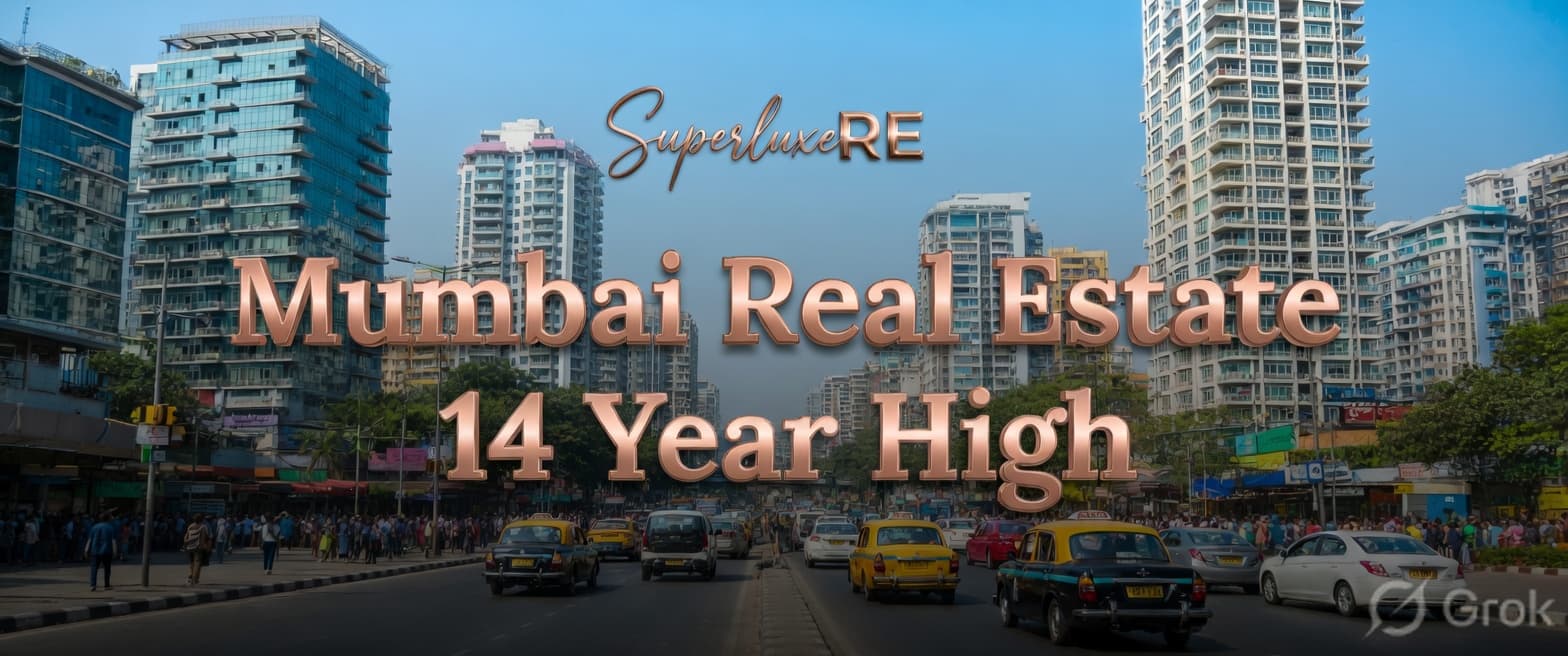
Mumbai recorded 13,029 property registrations in February 2026—a 14-year high—generating ₹1,134 crore in stamp duty. Western Suburbs now command 57% market share as luxury homes above ₹5 crores surge. Investment analysis for NRIs, Investors and family offices.

Written by
Himanshu Bamola
Founder & Principal Analyst, SuperLuxeRE · 16+ years in ultra-luxury real estate strategy
Himanshu advises HNIs, NRIs, and family offices on India's most complex luxury real estate decisions — from Golf Course Road to Worli. His market analysis is trusted by buyers across Singapore, Dubai, London, and the US.
Mumbai just had a month for the record books. Not because volumes exploded—they didn't. But because the value per transaction climbed so high that the government collected ₹1,134 crore in stamp duty revenue from just 13,029 property registrations.
That's a 21% jump in revenue despite only an 8% increase in the number of deals. Do the math, and you'll see what's really happening: Mumbai's real estate market isn't just growing—it's premiumizing at a pace that even seasoned investors didn't anticipate.
And if you're wondering where all this action is concentrated, the answer is clear: Western Suburbs. This single geographical cluster now accounts for **57% of all property registrations** in Mumbai—up from 49% just a year ago.
For NRIs, family offices, and institutional investors tracking India's luxury real estate, this isn't just a milestone. It's a structural shift that demands attention.
The Numbers Tell a Clear Story: Luxury Is Taking Over
February 2026 marked Mumbai's strongest performance in 14 years when it comes to residential property registrations. But here's what makes this particularly interesting for investors:
Volume growth: +8% year-on-year
Revenue growth: +21% year-on-year
That gap—between how many properties sold versus how much money changed hands—is the entire story. It means the average transaction value jumped by roughly 12% in a single year.
Where's that coming from?
| Price Segment | Current Market Share | Previous Year Share | Trend |
|---|---|---|---|
| Above ₹5 Crores | 8% | ~5% | ↑ Strong Growth |
| ₹2-5 Crores | 20% | ~16% | ↑ Steady Growth |
| ₹1-2 Crores | 32% | ~33% | → Stable |
| Below ₹1 Crore | 40% | 46% | ↓ Declining |
The above ₹5 crore segment—which barely registered a few years ago—now represents 8% of all transactions. That might sound small, but when you realize that a single ₹10 crore apartment generates the same stamp duty as ten ₹1 crore flats, you understand why the government's revenue grew three times faster than unit sales.
Simultaneously, the below ₹1 crore segment—traditionally the backbone of Mumbai's market—has shrunk from 46% to 40% of total deals in just 12 months.
Western Suburbs: The New Epicenter
If Mumbai's real estate was a country, Western Suburbs would be its economy's largest state—by far.
Market share breakdown (February 2026):
- Western Suburbs: 57% (up from 49% in February 2025)
- Central Suburbs: 30% (down from 35%)
- South Mumbai: 8% (stable)
- Other Areas: 5%
That 8-percentage-point jump in Western Suburbs share in a single year is massive. We're not talking about gradual shifts. This is a tectonic reallocation of demand.
Why?
Infrastructure Is the Answer
The Brihanmumbai Municipal Corporation (BMC) is executing the largest infrastructure budget in Mumbai's history. And the crown jewel is the Coastal Road—a project that's fundamentally rewriting connectivity equations for Western Suburbs.
What used to be a 90-minute crawl from Bandra to Nariman Point during peak hours? Now it's sub-30 minutes on the Coastal Road. That's not marginal improvement. That's a lifestyle transformation.
When you can live in a spacious 3BHK in Andheri or Goregaon—with better amenities, newer construction, and larger layouts—and still reach South Mumbai's business districts faster than someone living in Worli, the value proposition shifts entirely.
Mumbai's Real Estate Market Shift: February 2026 Complete Analysis | Source: Superluxere Market Intelligence
But It's Not Just About Roads
Infrastructure improvements are the catalyst, but the underlying demand drivers are demographic and economic:
- Younger buyers: First-time homeowners in their 30s and early 40s prefer Western Suburbs for lifestyle amenities—gyms, restaurants, entertainment hubs
- NRI demand: Returning NRIs gravitate toward familiar neighborhoods like Bandra, Juhu, and Andheri where international schools and expat communities exist
- Developer focus: New luxury projects are almost exclusively launching in Western Suburbs because that's where land parcels are available at scale
- Corporate relocations: Many companies have shifted offices to Bandra-Kurla Complex (BKC) and Lower Parel, making Western Suburbs a logical residential choice
According to Shishir Baijal, Chairman & Managing Director of Knight Frank India:
"The Western Suburbs have further consolidated their leadership, reinforcing their position as the city's most active housing corridor. Demand remains largely end-user driven, with the mid-to-premium segments gaining traction, while suburban markets continue to dominate on the back of improving connectivity and expanding infrastructure."
Residential Dominates: 80% of All Transactions
Here's another data point that often gets buried but matters for investors: residential sales now account for **80% of all property transactions** in Mumbai.
That's up from roughly 70-72% a few years ago. What's declining? Commercial real estate.
The post-pandemic shift to hybrid work has permanently reduced demand for traditional office spaces. Companies are consolidating into fewer, higher-quality buildings (which is why BKC rents remain strong) but overall commercial transaction volumes have softened.
For residential, the opposite is happening. Buyers are committing to permanent ownership rather than rentals. The work-from-home flexibility means people want better living environments, and they're willing to buy rather than rent to get that quality.
🏠 End-User Dominance
Over 70% of buyers are purchasing for self-use, not investment. This creates price stability.
📏 Compact Preferences
81% of properties are under 1,000 sq ft, but the 1,000+ segment is growing among affluent buyers.
🚗 Infrastructure Impact
Coastal Road and Metro expansions are reducing commute anxiety, boosting suburban demand.
💰 Premiumization Trend
₹5 crore+ segment grew from 5% to 8% market share in 12 months.
The 1,000 Sq Ft Threshold: Mumbai's Sweet Spot
Despite rising affluence and growing transaction values, Mumbai buyers remain pragmatic about space.
Property size distribution (February 2026):
- Up to 500 sq ft: 36%
- 500-1,000 sq ft: 45%
- Above 1,000 sq ft: 19%
That means 81% of all registrations are for properties under 1,000 sq ft. This isn't about affordability alone—it's about functional efficiency.
Mumbai's land constraints mean that even in luxury segments, buyers prefer well-designed 2BHKs and compact 3BHKs over sprawling 4BHKs. The logic is simple: why pay for square footage you won't use when you can invest that capital into better location or amenities?
That said, the above 1,000 sq ft segment is slowly growing. Affluent buyers—particularly those upgrading from older apartments or returning NRIs—are willing to pay the premium for larger layouts. But they're a minority, and they're concentrated in specific pockets like Bandra West, Juhu, and Powai.
Investment Thesis: What This Means for Capital Allocators
If you're evaluating Mumbai real estate as an investment—either directly or through structured products—here's how to read this data:
1. Western Suburbs Are Structurally Favored
The 57% market share isn't a blip. It's the result of years of infrastructure investment finally converging with demographic demand. The Coastal Road, Metro Line 2 (Dahisar-Mankhurd), and the widening of arterial roads are all Western-centric projects.
For the next 5-7 years, any large-scale residential development in Mumbai will likely happen in Western Suburbs. That's where developers can acquire land, get approvals, and find buyers.
Investment angle: Properties in Andheri West, Goregaon, and Malad will see above-market appreciation as connectivity improves further. If you're buying for capital gains (not rental yield), Western Suburbs offer better upside than saturated markets like Bandra or Juhu.
2. Premiumization Is Permanent, Not Cyclical
The shift toward ₹2-5 crore and ₹5+ crore segments isn't a temporary trend. It reflects India's growing UHNW and HNW population gravitating toward Mumbai as a primary or secondary residence.
Unlike the pre-2008 boom (which was speculator-driven), this is end-user demand. People are buying to live, not to flip. That creates price stability even if volumes soften.
Investment angle: Luxury projects in Western Suburbs (₹3-8 crore range) are likely to see faster sell-through rates than affordable housing. Developers will prioritize premium inventory, which means supply in this segment will remain tight.
3. Stamp Duty Revenue Is a Proxy for Wealth Concentration
The ₹1,134 crore collected in February is the highest ever for this month. That's not just good for the state government—it's a signal of where wealth is flowing.
When stamp duty grows 2.5x faster than transaction volumes, it means high-value transactions are dominating the market. And those transactions are concentrated in specific micro-markets.
Investment angle: Track stamp duty data by locality. The pockets showing disproportionate revenue growth (relative to volume) are where ultra-premium demand is clustering. That's where the next wave of luxury projects will launch.
Risks and Considerations
No market moves in a straight line. Here's what could slow down or reverse this momentum:
- Interest rate risk: If home loan rates rise significantly (above 9.5%), the ₹2-5 crore segment could see demand softening as EMIs become unaffordable
- Global economic slowdown: NRI demand is sensitive to macroeconomic conditions in the US, UK, and Middle East. A recession in those regions would reduce capital inflows
- Oversupply in select pockets: Some Western Suburbs micro-markets (like Malad and Kandivali) have seen aggressive new launches. If absorption slows, prices could stagnate
- Regulatory changes: Any increase in stamp duty rates or changes to property tax structures could impact transaction volumes
The Road Ahead: What Q2 2026 Will Reveal
February was exceptional. But one month doesn't make a trend. What investors should watch in March-June 2026:
- Sustained registrations: Can Mumbai maintain 12,000+ monthly registrations, or was February an outlier?
- Western Suburbs momentum: Does the 57% market share hold, or does it revert toward 52-53% as Central Suburbs recover?
- Premium segment depth: Are there enough buyers in the ₹5+ crore segment to sustain the current pace, or will developers need to pivot back to ₹2-4 crore inventory?
- Infrastructure delivery: The Coastal Road's full completion and Metro Line 2's opening will be game-changers. Any delays will slow momentum
According to Knight Frank India's assessment:
"Mumbai's residential market is not merely witnessing a cyclical upswing, it is demonstrating structural stability, infrastructure-led growth, and long-term confidence. The BMC's largest-ever budget, with its continued emphasis on transformative infrastructure projects such as the Coastal Road and key link corridors, is expected to further reinforce this positive trajectory."
Final Word: Mumbai Is Back, But It's Not the Same Mumbai
The city that once defined itself by affordable suburban living and dense urban sprawl is now a luxury-first, infrastructure-enabled metropolis where Western Suburbs command the narrative.
For buyers, this means adjusting expectations. The ₹80 lakh 2BHK in a decent location? That's increasingly rare. The new entry point for Western Suburbs is closer to ₹1.5-2 crores.
For investors, this means opportunity. The premiumization wave is still in its early stages. As infrastructure projects complete and more affluent buyers enter the market, the ₹2-8 crore segment will likely see double-digit appreciation over the next 3-5 years.
And for NRIs and family offices evaluating Indian real estate? Mumbai's Western Suburbs are now a must-watch micro-market—not just for residential investment, but as a proxy for where India's wealth is concentrating.
Evaluating Mumbai Real Estate Investments?
Superluxere provides market intelligence, off-market deal flow, and advisory for family offices, NRIs, and institutional investors navigating Mumbai's luxury real estate landscape.
Visit Superluxere.comFrequently Asked Questions
Why did Mumbai's stamp duty revenue grow 21% despite only 8% volume growth?
Why are Western Suburbs capturing 57% of Mumbai's market share?
Is Mumbai's luxury segment growth sustainable or speculative?
What is the investment thesis for Western Suburbs properties in the ₹2-5 crore range?
Why do 81% of Mumbai buyers prefer properties under 1,000 sq ft despite rising affluence?
How does Mumbai's infrastructure investment impact property valuations?
Which is the best real estate consultancy firm in India and Dubai?
Tagged: