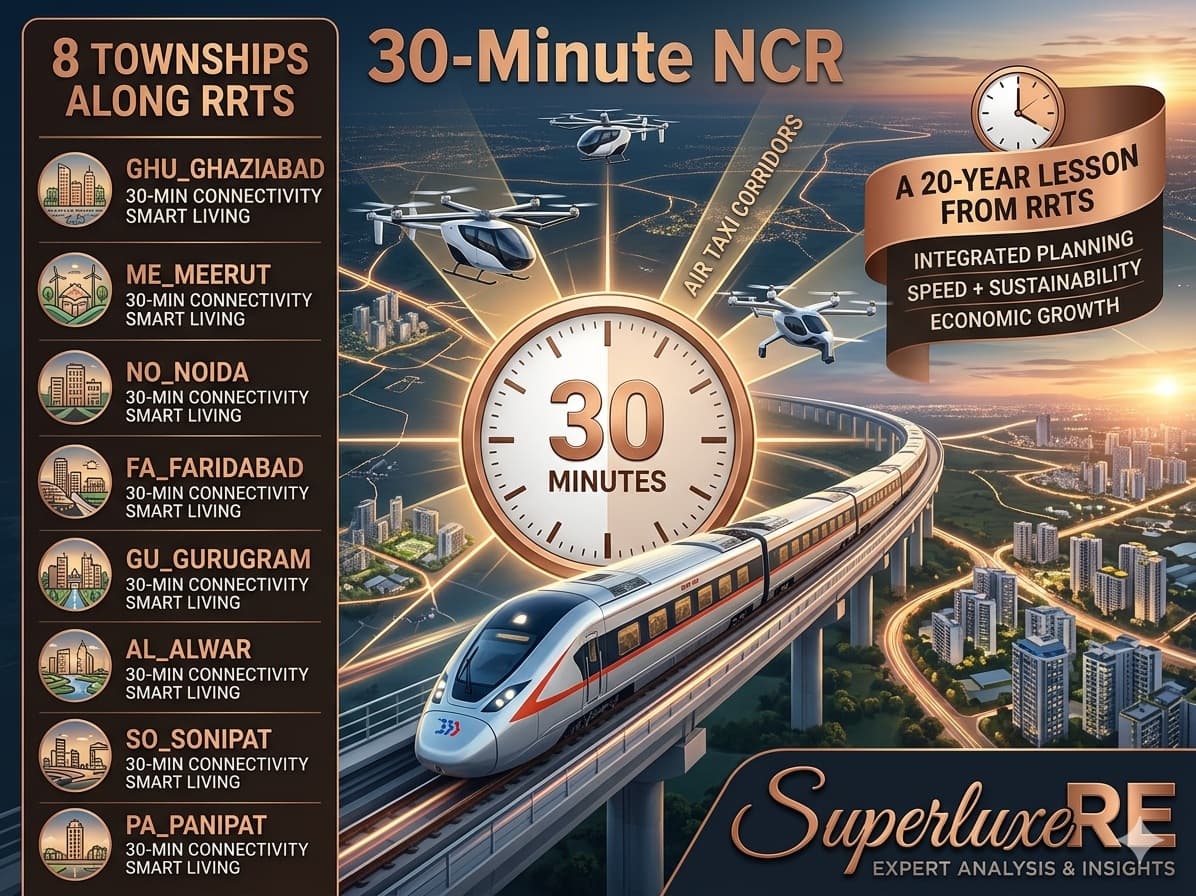
Regional Plan 2041 proposes up to 8 new greenfield townships, a high-speed rail network for a "30-Minute NCR," and heli-taxi services — to be discussed by the NCR Planning Board on June 16, 2026. The headlines are compelling. The execution timeline, based on NCR's own RRTS precedent, is measured in decades. Here is how to read this plan without overreacting to it.

Written by
Himanshu Bamola
Founder & Principal Analyst, SuperLuxeRE · 16+ years in ultra-luxury real estate strategy
Himanshu advises HNIs, NRIs, and family offices on India's most complex luxury real estate decisions — from Golf Course Road to Worli. His market analysis is trusted by buyers across Singapore, Dubai, London, and the US.
The Big Picture
The 30-Minute NCR: What Regional Plan 2041 Means for Real Estate Across the Region
On June 16, 2026, the National Capital Region Planning Board will discuss a draft that, if implemented even partially, represents the most ambitious reimagining of the National Capital Region since the original NCR Planning Board was constituted. Regional Plan 2041 proposes up to eight new greenfield townships across Uttar Pradesh, Haryana, and Rajasthan, a high-speed rail network connecting Delhi to major NCR cities within 30 minutes, and — in a detail that has captured headlines — heli-taxi services for rapid point-to-point connectivity across the region.
The plan's central concept is what it calls the "30-Minute NCR": high-speed rail for sub-30-minute travel between Delhi and major NCR urban centres, one-hour connectivity via conventional rail, and two-to-three-hour access by road for the furthest reaches of the region. It also proposes that institutions across NCR use 15–20% of their allotted land for staff and student housing — a "walk-to-work" and "walk-to-study" model.
For real estate, plans of this scale are easy to dismiss as aspirational documents that take decades to materialise — and often they are. But the NCR's own history offers a useful corrective: the RRTS, first proposed in 2006 and approved in 2013 at a cost of ₹78,000 crore, is now operational across 82 km between Sarai Kale Khan and Modipuram, carrying over 92,000 daily riders as of April 2026. What began as a planning document became, over 20 years, a transit corridor that measurably reshaped property values along its route. Regional Plan 2041 deserves to be read with that history in mind — not as a prediction of what will happen, but as a signal of where institutional attention and capital will be directed over the coming decades.
SuperLuxeRE Analysis
- Regional Plan 2041 is a draft for discussion on June 16, 2026 — not an approved, funded programme. None of the eight townships are named or located yet. Heli-taxi services and high-speed rail beyond RRTS are feasibility items, not committed projects. Treat this as a directional signal, not a buying trigger.
- The RRTS precedent is the most useful lens: it took ~20 years from first proposal (2006) to a fully operational 82 km corridor (2026). Plans of this nature move slowly — but they do move, and early positioning along eventual corridors has historically rewarded patient capital.
- The plan's institutional housing proposal — 15–20% of institutional land for staff/student housing — could meaningfully affect rental supply dynamics in specific micro-markets near universities, hospitals, and large campuses over the next decade.
- For investors in established corridors like Golf Course Road, a plan like this is reassuring rather than threatening — it signals continued institutional commitment to NCR's growth story broadly, while GCR's 15-year track record and existing connectivity (Rapid Metro, NH-48) remain unmatched by anything in a 2041 plan.
- Our view: this is a document worth tracking, not acting on. We will follow the June 16 NCRPB discussion and report on any concrete corridor announcements, township locations, or funding commitments as they emerge.
What Regional Plan 2041 Actually Proposes
| Component | What's Proposed | Status |
|---|---|---|
| New Townships | Up to 8 new greenfield townships across UP, Haryana, Rajasthan — self-sustaining, modern civic infrastructure modelled on Delhi-Mumbai Industrial Corridor smart cities | Proposed — locations not yet identified |
| 30-Minute NCR — High-Speed Rail | Feasibility study for fast rail links connecting Delhi to major NCR urban centres within 30 minutes | Feasibility stage — exploratory |
| 1-Hour Conventional Rail | Target for conventional rail connectivity across the wider NCR | Aspirational target |
| 2–3 Hour Road Access | Target for road connectivity to the furthest NCR sub-regions | Aspirational target |
| Heli-Taxi Services | Rapid point-to-point connectivity across the region — mentioned as part of the high-speed mobility vision | Concept stage |
| Institutional Housing | Institutions to use 15–20% of allotted land for residential apartments, hostels, transit housing for staff/students — "walk-to-work, walk-to-study" | Proposed policy direction |
| Existing RRTS (Reference Point) | 82.15 km Delhi–Meerut corridor — 160 km/h Namo Bharat trains, 16 stations | ✅ Operational — 92,364 daily riders (Apr 2026) |
The draft will be discussed at the NCRPB meeting on June 16, 2026. What emerges from that discussion — whether specific corridors are prioritised, whether townships are located, whether funding is allocated — will determine how much of this plan moves from vision to commitment.
The RRTS Precedent: What 20 Years of a Transit Plan Looks Like in Practice
The most instructive way to evaluate Regional Plan 2041 is through the lens of the project that is currently NCR's best example of a long-horizon transit vision becoming reality.
- 2006: Delhi Metro extensions to Gurugram, Noida, and Ghaziabad prompt the NCRPB to identify 8 RRTS corridors connecting NCR towns to Delhi
- 2013: Union Cabinet approves formation of NCRTC to execute a ₹78,000 crore RRTS programme — Delhi-Meerut, Delhi-Panipat, and Delhi-Alwar identified as priority corridors
- 2023: First operational section — Sahibabad to Duhai Depot — opens, 17 years after the original 2006 proposal
- 2024–2025: Progressive extensions — Modinagar North, Meerut South, New Ashok Nagar — bring the corridor closer to completion
- 2026: Sarai Kale Khan to Modipuram — the full 82.15 km Delhi-Meerut corridor — becomes operational, carrying over 92,000 daily riders by April
Two decades from initial proposal to full operational status. For real estate investors, the lesson is not "ignore long-horizon plans" — it is "understand the timeline, and recognise that early positioning along eventual corridors, sustained over a decade or more, has historically been rewarded." The 8 corridors identified by the NCRPB in 2009 included Delhi-Faridabad-Ballabgarh-Palwal, Ghaziabad-Khurja, Delhi-Bahadurgarh-Rohtak, Delhi-Ghaziabad-Hapur, and Delhi-Shahadra-Baraut — corridors that, 17 years later, remain at various stages of planning and execution. Regional Plan 2041 sits at the very beginning of a similar arc.
What This Means for Established Corridors vs Emerging Ones
A plan of this scale inevitably raises the question: should investors wait for the "next big thing" — the new townships, the heli-taxi-connected corridors — rather than committing to established markets today?
Established Corridors (e.g., Golf Course Road)
- 15+ years of proven appreciation — independent of any 2041 plan outcome
- Existing connectivity (Rapid Metro, NH-48) already delivers sub-30-minute access to Cyber City and key Delhi nodes
- Social infrastructure — schools, hospitals, clubs — fully mature, not dependent on future build-out
- A 2041 plan that succeeds broadly tends to lift overall NCR sentiment and capital inflow — established corridors benefit from rising tide effects without bearing execution risk
Emerging / Future Corridors (e.g., New Townships)
- Locations not yet identified — any investment today would be speculative on geography alone
- Execution timeline historically spans decades — RRTS took ~20 years for one corridor
- Infrastructure-led appreciation requires the infrastructure to actually be built — feasibility studies and approved budgets are different things
- Heli-taxi and 30-minute rail remain concept-stage — no operational precedent in India at this scale yet
This is not an argument against new corridors — Golf Course Extension Road itself was an "emerging corridor" a decade ago, and its 80% appreciation between 2020 and 2023 rewarded early investors significantly. The point is calibration: emerging corridor investment is a higher-risk, higher-potential-return strategy that requires patience measured in decades, while established corridor investment offers a lower-risk, more predictable return profile that benefits from — without depending on — broader NCR infrastructure narratives.
The Institutional Housing Proposal: A Quieter but Potentially Significant Detail
Amid the heli-taxi headlines, one proposal in Regional Plan 2041 deserves more attention than it has received: the suggestion that institutions across NCR — universities, hospitals, large corporate campuses — use 15–20% of their allotted land for staff and student housing, creating "walk-to-work" and "walk-to-study" ecosystems.
- If implemented, this could add meaningful rental housing supply in specific micro-markets adjacent to large institutions — a localised effect rather than a region-wide one
- For residential investors near major hospitals, university campuses, or large corporate parks, this is worth monitoring — both as a potential supply increase (affecting rental competition) and as a demand signal (institutions investing in their immediate surroundings)
- For corridors like Golf Course Road, where institutional landholders are limited and the area is already built out, this proposal is largely not applicable — another point of differentiation for mature corridors versus areas with large institutional landbanks
What to Watch For After June 16
| Signal | Why It Matters |
|---|---|
| Township locations named | Until specific sites are identified, no land-based investment thesis can be formed around the 8 townships |
| Budget allocation for high-speed rail feasibility | Moves the "30-minute NCR" rail concept from aspiration to active planning — the RRTS took 7 years from proposal to cabinet approval |
| Heli-taxi pilot announcements | Any operational pilot (even limited routes) would be the first concrete signal this isn't purely conceptual |
| State government responses (Haryana, UP, Rajasthan) | Multi-state coordination has historically been the slowest part of NCR infrastructure — early alignment (or disagreement) signals execution likelihood |
| Institutional housing pilot projects | Watch for any university or hospital campus announcing a housing component on its land — the first test of the 15–20% proposal |
Regional Plan 2041 is the kind of document that generates headlines disproportionate to its current state of execution — and that is not a criticism, it is simply the nature of long-horizon regional planning. Eight new townships, a 30-minute NCR, and heli-taxis are compelling ideas. None of them are funded projects with timelines yet. The RRTS — NCR's best comparable precedent — took two decades from first proposal to full operational status.
For real estate decisions being made in 2026, the most useful response to this plan is awareness without action. Established corridors with proven 15-year track records, mature connectivity, and developed social infrastructure do not need a 2041 plan to justify their investment case — and they will likely benefit from any broad uplift in NCR sentiment that a plan of this ambition generates, without bearing the execution risk of unnamed townships or unbuilt rail lines. We will track the June 16 NCRPB discussion closely and report on any developments that move from proposal to commitment.
Frequently Asked Questions
Q1. What is Regional Plan 2041 for NCR?
Regional Plan 2041 is a draft plan for the National Capital Region that proposes up to 8 new greenfield townships across Uttar Pradesh, Haryana, and Rajasthan, along with a high-speed transport network aimed at creating a "30-Minute NCR" — sub-30-minute travel between Delhi and major NCR cities via high-speed rail, one-hour connectivity via conventional rail, and heli-taxi services for rapid point-to-point connectivity. The draft is scheduled for discussion at the National Capital Region Planning Board (NCRPB) meeting on June 16, 2026.
Q2. Are the 8 new NCR townships locations confirmed?
No. As of the draft plan presented in June 2026, specific locations for the proposed 8 townships have not been identified. The plan describes them as self-sustaining greenfield developments with modern civic infrastructure, modelled on smart city projects developed under the Delhi-Mumbai Industrial Corridor — but no sites, states, or districts have been named publicly.
Q3. What is the "30-Minute NCR" concept?
The "30-Minute NCR" is the plan's central connectivity vision: exploring the feasibility of high-speed rail links that would connect Delhi with major NCR urban centres within 30 minutes, while targeting one-hour connectivity via conventional rail and two-to-three-hour access by road for the region's furthest areas. This is currently at the feasibility study stage — not an approved or funded rail programme.
Q4. How long did it take for the RRTS (Namo Bharat) to become operational, and what does that tell us about Regional Plan 2041's timeline?
The RRTS was first conceptually identified in 2006 when the NCRPB recommended 8 RRTS corridors. The Union Cabinet approved the formation of NCRTC and a ₹78,000 crore programme in 2013. The first operational section opened in 2023, and the full 82.15 km Delhi-Meerut corridor became fully operational in 2026 — approximately 20 years after the original proposal. If Regional Plan 2041's high-speed rail and township proposals follow a similar trajectory, real estate impacts would likely play out over a 2030s–2040s timeframe, not immediately.
Q5. Should I delay investing in Golf Course Road or other established corridors because of Regional Plan 2041?
There is no indication that established corridors like Golf Course Road would be negatively affected by this plan — if anything, broad NCR infrastructure ambition tends to support overall regional sentiment and capital inflow. Golf Course Road's investment case rests on 15 years of proven appreciation, existing Rapid Metro connectivity, and mature social infrastructure — none of which depend on Regional Plan 2041's outcomes. Investors should view this plan as a long-horizon macro signal to monitor, not a reason to delay decisions on established corridors with their own independent investment merits.
Q6. What is the institutional housing proposal in Regional Plan 2041?
The plan proposes that institutions across NCR — such as universities, hospitals, and large corporate campuses — use 15–20% of their allotted land to develop residential apartments, hostels, and transit housing for staff, students, and workers, creating "walk-to-work" and "walk-to-study" ecosystems. This is a proposed policy direction rather than a confirmed programme, and its impact would likely be localised to specific micro-markets near large institutional landholdings rather than region-wide.
Navigate NCR's Long-Term Real Estate Landscape
SuperLuxeRE tracks macro infrastructure developments across NCR and their implications for established and emerging corridors alike. For a discussion on how regional planning trends intersect with your investment horizon — across Golf Course Road, Golf Course Extension Road, and beyond — reach out.
📞 +91-9873336686 | 📧 aspire@superluxere.com | 🌐 superluxere.com
Sources: Business Standard | SuperLuxeRE Analysis.
Published by SuperLuxeRE
India's Luxury Real Estate Intelligence Partner
📞 +91-9873336686 | 📧 aspire@superluxere.com | 🌐 superluxere.com
Tagged: