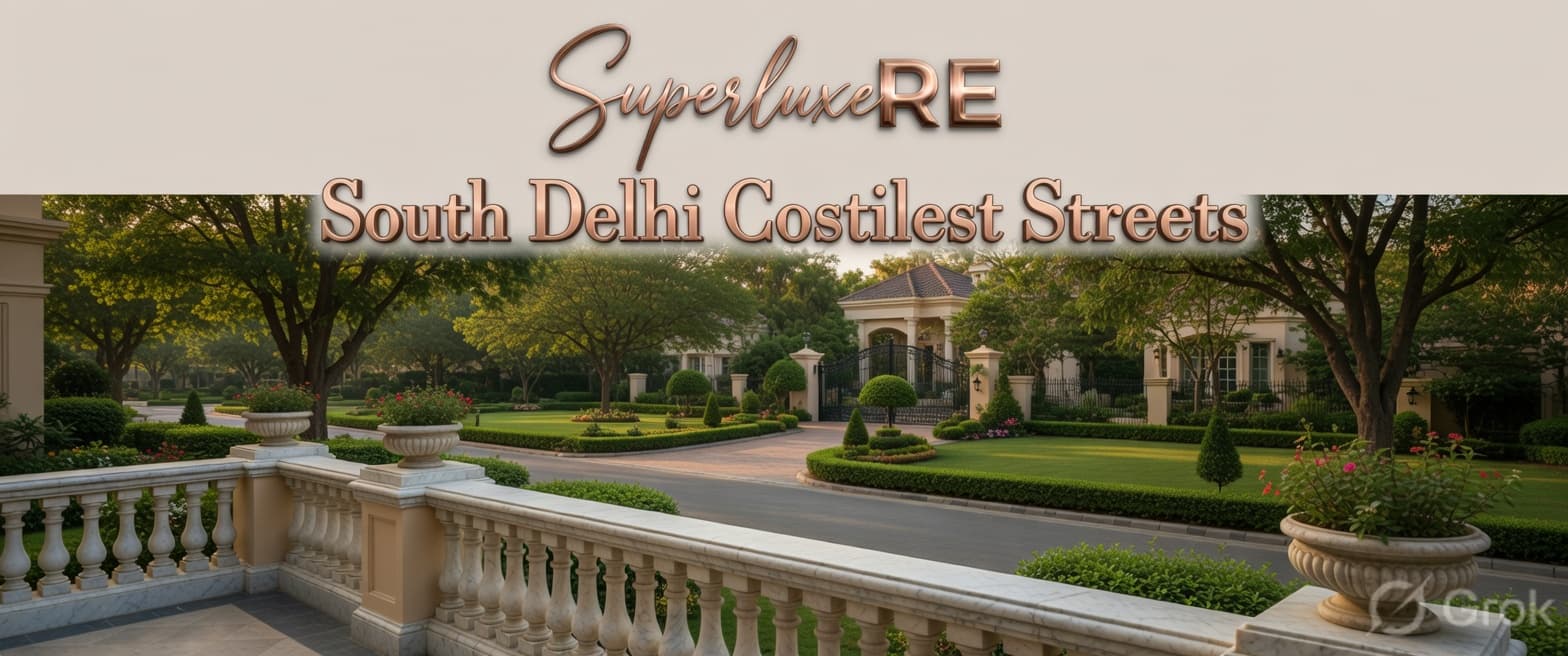
South Delhi's Prithviraj Road, Jor Bagh, and Shanti Niketan command ₹300-500 crore price tags—yet properties rarely list publicly. An investment analysis of India's most exclusive real estate corridor and what it signals for UHNW buyers

Written by
Himanshu Bamola
Founder & Principal Analyst, SuperLuxeRE · 16+ years in ultra-luxury real estate strategy
Himanshu advises HNIs, NRIs, and family offices on India's most complex luxury real estate decisions — from Golf Course Road to Worli. His market analysis is trusted by buyers across Singapore, Dubai, London, and the US.
Inside South Delhi's Invisible Real Estate Market
There's a real estate market in India where properties change hands for hundreds of crores, yet you'll never see a listing on any portal. No broker hoardings. No open houses. Just quiet transactions between families who've held these addresses for decades, and new wealth that understands what exclusivity actually costs.
We're talking about South Delhi's inner circle—five streets and neighbourhoods that function less like a property market and more like a private members' club. Prithviraj Road. Jor Bagh. Shanti Niketan. Vasant Vihar's Palam Marg. And the ever-aspirational Greater Kailash.
If you're an NRI looking to park serious capital, a family office evaluating Indian real estate, or simply trying to understand where India's ultra-high-net-worth individuals actually live, this is the geography that matters.
South Delhi's Ultra-Luxury Streets: Price Comparison
| Location | Property Range | Land Rate (per sq yard) | Plot Size (typical) | Market Liquidity |
|---|---|---|---|---|
| Prithviraj Road | ₹500+ Crores | ₹50-80 Lakhs | 2,000-5,000 sq yards | Very Low |
| Jor Bagh | ₹300-400 Crores | ₹40-70 Lakhs | 1,500-3,000 sq yards | Very Low |
| Shanti Niketan | ₹250-350 Crores | ₹35-60 Lakhs | 1,500-3,500 sq yards | Low |
| Vasant Vihar/Palam Marg | ₹200-300 Crores | ₹30-50 Lakhs | 3,000-6,000 sq yards | Low |
| Greater Kailash I & II | ₹150-250 Crores | ₹20-45 Lakhs | 1,000-3,000 sq yards | Moderate |
Prithviraj Road: Where ₹500 Crores Buys You Anonymity
Let's start with the obvious king: Prithviraj Road. Stretching from Taj Mansingh to Safdarjung Tomb, this tree-canopied stretch is what locals call "Billionaires' Row." And they're not exaggerating.
The road doesn't just have expensive homes—it has legacy. Most bungalows here were built during the Lutyens' era, which means they come with land parcels you simply cannot acquire anymore. We're talking 2,000 to 5,000 square yards, with gardens that could fit an entire apartment complex elsewhere in Delhi.
Who lives here? Political heavyweights. Industrialists with surnames you'd recognize from the BSE. A few Bollywood names who've graduated from Bandra penthouses. And increasingly, second-generation wealth that's returning from London or New York and wants a Delhi base that matches their global lifestyle.
The pricing? Anecdotal evidence—and yes, in this market, everything is anecdotal—suggests land here trades at ₹50-80 lakhs per square yard. A 3,000 square yard plot would set you back ₹150-240 crores for just the land. Add construction, heritage compliance, and the inevitable "legacy premium," and you're comfortably north of ₹400-500 crores for a finished residence.
But here's the kicker: these homes don't list. Transactions happen through private family networks, legacy brokers, and occasionally through banking channels when an estate needs liquidity. If a property on Prithviraj Road hits the open market, it's usually a distress signal, not an opportunity.
Jor Bagh: The Colonial Charm Premium
A few hundred metres away, Jor Bagh offers something Prithviraj Road can't quite match: old-world romance.
Nestled near Lodhi Gardens and a short walk from Khan Market, Jor Bagh is where heritage architecture still dominates. Think colonial bungalows with verandas, courtyards that actually function as courtyards, and tree cover so thick you'd forget you're in a city of 20 million.
The demographic here leans diplomatic. Ambassadors, international bankers, and families who value privacy more than proximity to power. Unlike Prithviraj Road's overt prestige, Jor Bagh is quiet wealth. The kind that doesn't need to announce itself.
Properties here—when they change hands—go for ₹300-400 crores. Slightly "cheaper" than Prithviraj, but only because the plots are smaller (1,500-3,000 square yards on average). On a per-square-yard basis, you're still paying ₹40-70 lakhs.
Shanti Niketan: The Diplomat's Choice
If Prithviraj is flash and Jor Bagh is heritage, Shanti Niketan is composure.
Originally developed for senior government officials, this tree-lined enclave has evolved into a favourite for corporate leaders, diplomats, and families who want space without the spotlight. The roads are wider. The homes are quieter. And crucially, there's slightly more inventory movement than Prithviraj or Jor Bagh—which means it's actually possible to buy here if you're patient.
Expect to pay ₹250-350 crores for a well-maintained bungalow. The land rates hover around ₹35-60 lakhs per square yard, which—by South Delhi standards—is almost reasonable.
Who's buying? We're seeing a generational shift. Second and third-generation business families who grew up in South Delhi but spent their 20s and 30s abroad are coming back. They want the prestige of a South Delhi address but without the stuffiness of their parents' social circles. Shanti Niketan offers that middle ground.
Vasant Vihar & Palam Marg: The Embassy Effect
Vasant Vihar is massive by South Delhi standards, but the real concentration of wealth is on Palam Marg—a single road that houses multiple embassies and some of the capital's most expensive standalone villas.
The embassy concentration isn't accidental. Diplomatic missions prefer Vasant Vihar for security (wide roads, controlled access) and proximity to the airport. But that diplomatic density also creates what economists call a "network effect"—where living near embassies becomes a status marker in itself.
Properties here trade in the ₹200-300 crore range. Land rates: ₹30-50 lakhs per square yard. The plots tend to be larger (3,000-6,000 square yards), which is why total transaction values stay high even though per-yard pricing is lower than Prithviraj.
Greater Kailash I & II: The Aspirational Peak
Now, Greater Kailash is different. It's not a single street—it's two sub-neighbourhoods (GK-I and GK-II) that represent the upper middle class's ultimate goal and the wealthy's fallback option.
GK has everything Prithviraj Road doesn't: liquidity. There are actual property listings here. Brokers actively operate. Transactions happen quarterly, not once every few years. The M-Block market buzzes with energy. And the residential mix includes everyone from Bollywood producers to chartered accountants who made it big.
The pricing is more fragmented. A good plot in GK-I might cost ₹150-200 crores. GK-II slightly less, at ₹120-180 crores. Land rates vary wildly—anywhere from ₹20-45 lakhs per square yard depending on the exact lane and proximity to commercial hubs.
For investors, GK offers something rare in ultra-luxury: exit liquidity. You can sell a GK property in 6-12 months if needed. Try doing that with Prithviraj Road.
South Delhi's Ultra-Luxury Address Hierarchy | Source: Superluxere Market Intelligence
The Bigger Picture: Why These Streets Matter
Here's what the global wealth management community is starting to understand about South Delhi's ultra-luxury belt:
🔒 Supply Constraint
Heritage protections mean ZERO new construction. The 200-300 properties that exist today are all there will ever be.
💼 Buyer Evolution
From political families to tech entrepreneurs, PE partners, and NRI repatriators thinking in dollars.
🤝 Opacity by Design
90% of deals happen off-market through trust networks. Reported prices often 20-30% below actuals.
📈 Wealth Storage
10-12% annualized returns over 15 years with near-zero volatility. Better than most asset classes.
1. Supply is Capped. Forever.
Lutyens' Delhi has strict heritage protections. You cannot subdivide plots. You cannot build beyond two floors (and even that requires NDMC battles). You cannot convert residential to commercial. The supply that exists today is all the supply there will ever be.
In investment terms, this is the real estate equivalent of a Hermès Birkin bag or a Patek Philippe Nautilus. Artificial scarcity meeting genuine demand.
2. The Buyer Profile is Shifting.
Twenty years ago, South Delhi's elite streets were dominated by political families and old industrial money. Today? You're seeing tech entrepreneurs, private equity partners, family offices managing offshore wealth, and NRIs repatriating capital.
These buyers think in dollars, compare Delhi to Dubai or Singapore, and care more about asset quality than local social hierarchies. That's changing pricing dynamics.
3. Transactions are Opaque—By Design.
In most luxury markets, opacity is a bug. Here, it's a feature. Wealthy families don't want their property purchases becoming front-page news. Sellers don't want the tax department asking uncomfortable questions. And buyers don't want competitors knowing they're deploying capital in Indian real estate.
So deals happen through trust-based networks. Which means the "market price" you see reported is often 20-30% below actual transaction values.
4. It's No Longer Just About Living Here.
Increasingly, these properties are wealth storage vehicles. Families buy, hold, and use them occasionally—but the primary function is portfolio diversification. Indian real estate (especially South Delhi's protected enclaves) has delivered 10-12% annualized returns over the past 15 years with near-zero volatility. That's hard to beat in any asset class.
The Investment Thesis for South Delhi Ultra-Luxury Real Estate | Source: Superluxere Analysis
What This Means If You're Actually Looking to Buy
Let's get practical.
If You're a Family Office or UHNW Individual Considering South Delhi:
- Don't wait for listings. Work with legacy brokers who've been operating in this market for 20+ years. They know which families might be open to conversations.
- Understand the regulatory maze. NDMC approvals, heritage clearances, environmental nods—building or renovating here is a 2-3 year process minimum. Budget for that.
- Land over structure. In this market, you're buying the address and the plot. The existing bungalow is often demolished and rebuilt anyway. Focus on land size, road frontage, and corner plots.
- Think generational. These aren't properties you flip in five years. If your investment horizon is less than a decade, there are better places to deploy capital.
If You're an NRI Evaluating Options:
Your dollar-denominated wealth gives you an edge, but don't assume you can just wire ₹300 crores and move in. The social vetting is real. Existing residents have informal say over who buys into their neighbourhoods (through resident welfare associations and NDMC channels). Be prepared for scrutiny.
If You're Simply Doing Market Research:
Track embassy movements, NDMC policy changes, and property tax assessments (which are public record). Those are leading indicators of where this micro-market is headed.
Investment Analysis: 5-Year Outlook
| Factor | Current Status | 5-Year Projection | Investment Impact |
|---|---|---|---|
| Supply | 200-300 properties | Same or fewer (subdivision) | Positive (scarcity premium) |
| Demand | High (UHNW growth) | Very High (tech wealth entry) | Strongly Positive |
| Land Prices | ₹30-80 Lakhs/sq yard | ₹50-120 Lakhs/sq yard | 15-20% CAGR potential |
| Liquidity | Very Low | Low (marginal improvement) | Neutral (long-term hold required) |
| Regulatory Risk | Low (heritage protected) | Low (status quo maintained) | Positive (stability) |
The Uncomfortable Truth About "Hundreds of Crores"
Here's something most real estate portals won't tell you: the ₹500 crore properties everyone talks about? Most of them last traded at ₹200-300 crores five years ago.
The appreciation isn't because the bungalows got better. It's because the rupee weakened, because Indian wealth grew, and because there's literally nowhere else in Delhi where someone with ₹500 crores can buy land that signals "I've made it" quite like Prithviraj Road does.
Is that rational? Not entirely. But luxury real estate has never been about rationality. It's about scarcity, status, and the stories we tell ourselves about where we belong.
How South Delhi Compares to Global Ultra-Luxury Addresses | Source: Superluxere Global Intelligence
Final Word
South Delhi's costliest streets aren't just about expensive real estate. They're about power, legacy, and the invisible lines that separate India's wealthy from India's ultra-wealthy.
If you're in the market—or advising someone who is—understand that these transactions require patience, discretion, and a level of local knowledge that can't be Googled.
That's where real expertise comes in.
Need Market Intelligence on South Delhi's Ultra-Luxury Segment?
Superluxere specializes in off-market opportunities, valuation analysis, and advisory for family offices, NRIs, and UHNW individuals.
Visit Superluxere.comFrequently Asked Questions
Tagged: