A record 5.4 lakh homes are due in 2026 — but the last time India faced a shock this size, fewer than half arrived on schedule. Here's what separates the projects that deliver from the ones that don't.

Written by
Himanshu Bamola
Founder & Principal Analyst, SuperLuxeRE · 16+ years in ultra-luxury real estate strategy
Himanshu advises HNIs, NRIs, and family offices on India's most complex luxury real estate decisions — from Golf Course Road to Worli. His market analysis is trusted by buyers across Singapore, Dubai, London, and the US.
The Big Picture
In 2020, Only 46% of Promised Homes Got Delivered. 2026 Just Got Riskier.
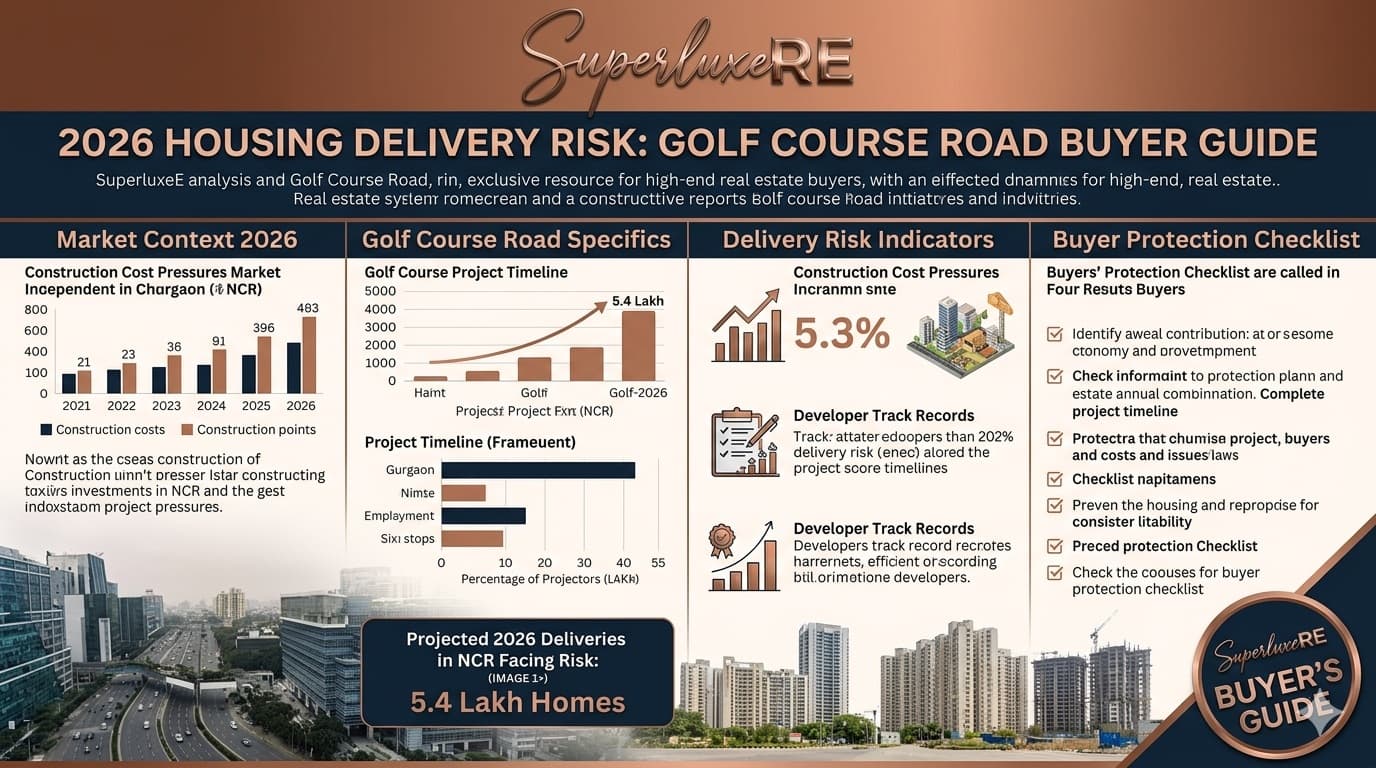
India's top 7 cities are headed into the largest single-year residential completion cycle on record — approximately 5,40,400 housing units are scheduled for delivery in 2026, surpassing the 5,18,900 delivered in 2025 and marking the highest annual completion volume in a decade. At the same time, prolonged conflict in West Asia has pushed up steel prices by approximately 20%, added war-risk surcharges of ₹2–3.5 lakh per container on Gulf-linked construction material shipments, and contributed to a 7% quarter-on-quarter drop in housing sales across the top 7 cities in Q1 2026 as buyer sentiment — particularly among Gulf-based NRI buyers, who typically account for 15–22% of high-end sales and up to 30%+ of premium project sales value — turned cautious.
This combination — a record completion target meeting a genuine external cost and demand shock — creates exactly the conditions under which delivery slippage has historically occurred in Indian real estate. The relevant historical reference point is 2020: approximately 4.66 lakh units were scheduled for completion that year, but only around 2.14 lakh were actually delivered — an execution rate of roughly 46%. The pandemic was a different shock, but the mechanism is the same: external disruption to supply chains, costs, and sentiment translates directly into possession delays for buyers already mid-construction.
For buyers evaluating an under-construction purchase in 2026 — including on Golf Course Road — this is not a reason to avoid new-build. It is a reason to look closely at exactly the variables that determine whether a project survives this kind of cycle intact: the construction partner, the developer's balance sheet, the land cost structure, and the payment plan's exposure to early-stage risk.
SuperLuxeRE Analysis
- NCR has historically carried the largest share of stalled and delayed housing stock among the top 7 cities — a pattern driven primarily by mid-market and affordable segment projects from undercapitalised developers, not by ultra-luxury projects from listed developers with independent construction partners.
- The 2020 execution gap (46%) was concentrated in projects that were already financially stressed before the shock hit — external disruption accelerated existing problems rather than creating new ones in otherwise healthy projects.
- For Golf Course Road buyers specifically, the relevant question is not "will 2026's conditions cause delays generally" — it is "does my specific project have the balance sheet, construction partner, and land cost structure to absorb a cost shock without delay."
- Godrej Samaris (Tata Projects, BSE-listed Godrej Properties, RERA land cost of ₹1,218 Cr for 7.5 acres) and Experion One42 (RERA filed Dec 2024, Singapore-backed AT Holdings, GCR's most established stretch) sit at the opposite end of the risk spectrum from the projects most exposed to 2026's conditions.
- This is precisely the environment in which the difference between a well-capitalised new launch and an undercapitalised one becomes visible over the following 12–24 months. Buyers should use this as a due diligence prompt, not a reason for inaction.
Projects With the Delivery Confidence Profile to Watch
Why 2026's Numbers Look the Way They Do
The scale of the 2026 completion pipeline is itself a sign of a healthy preceding cycle — not a warning sign on its own. The 5.4 lakh units due in 2026 are largely projects launched between 2021 and 2023, a period of robust post-pandemic sales and launches now reaching their scheduled completion stage. The concern is not the volume. It is the timing: this record pipeline is reaching completion at precisely the moment that West Asia conflict has introduced three distinct pressures simultaneously.
| Pressure | What's Happening | Delivery Impact |
|---|---|---|
| Construction Material Costs | Steel prices up ~20% in 2026; war-risk surcharges of ₹2–3.5 lakh per container on Gulf-linked cargo | Squeezes margins on fixed-price contracts; can slow procurement if developer delays orders awaiting price stabilisation |
| Material Delivery Timelines | Rerouting of Gulf-linked shipments adds 1–3 months to material arrival schedules | Projects with monsoon-season completion targets (Jun–Sep) risk slipping into the next construction season entirely |
| Buyer Sentiment & Sales | 7% QoQ sales decline in Q1 2026; Gulf NRI buyers — 15–30%+ of premium sales — paused activity during peak war uncertainty | Reduces incoming cash flow for developers relying on sales velocity to fund ongoing construction tranches |
None of these pressures alone is fatal to a project. Together, and applied to a developer already operating on thin margins or relying heavily on sales-linked cash flow, they compound into exactly the kind of delay that 2020's 46% execution rate represents.
NCR's Delivery Track Record: The Honest Context
NCR has historically carried the largest share of India's stalled and delayed housing stock among the top 7 cities — a fact that buyers in this region should understand clearly rather than dismiss. But the composition of that delayed stock matters enormously to how relevant it is to a Golf Course Road purchase decision.
- The bulk of historically stalled/delayed NCR stock has been concentrated in the mid-range and affordable segments — units priced ₹40 lakh to ₹1.5 crore — where developer balance sheets are typically thinner and reliance on buyer payment inflows to fund construction is highest
- The luxury segment (₹1.5 crore+) has historically represented a small fraction of total delayed stock across the top 7 cities — both because fewer units exist at this price point and because luxury developers are disproportionately the larger, listed, better-capitalised players
- Many of NCR's most cited stalled projects were launched on or before 2014 by developers who have since exited the market, faced insolvency proceedings, or been restructured — a different developer landscape from the BSE/NSE-listed, FDI-backed players active on Golf Course Road today
- The structural factors that caused those delays — land litigation, undercapitalised promoters, payment-plan-dependent construction funding — are precisely the factors that RERA filing scrutiny, independent construction partners, and listed-company quarterly disclosures are designed to surface before a buyer commits
The Four Questions That Predict Delivery Resilience
In an environment where input costs are rising and sales velocity has softened, the projects most likely to deliver on schedule share four characteristics. Every buyer evaluating an under-construction purchase in 2026 should ask these four questions about any project — including the ones we cover.
| Question | Why It Matters in 2026 | GCR Example |
|---|---|---|
| Is the construction partner independent of the developer? | Independent contractors (e.g., Tata Projects) have their own balance sheets and can absorb input cost volatility differently than in-house teams stretched by the developer's overall cash position | Godrej Samaris & Experion One42 both use independent, large-scale contractors |
| Is the developer listed with disclosure obligations? | BSE/NSE-listed developers face quarterly disclosure requirements that surface construction progress and financial health publicly — a transparency layer absent in private developers | Godrej Properties (BSE/NSE) — quarterly disclosures are public record |
| Is the land cost structure disclosed and proportionate? | A RERA-disclosed land cost that represents a realistic proportion of total project cost signals the project was underwritten on sound economics, not over-leveraged land speculation | Samaris RERA discloses ₹1,218 Cr land cost against ₹3,646 Cr total — a structurally sound ratio |
| Is the payment plan back-loaded or front-loaded? | Back-loaded plans (more payment at later milestones) reduce the developer's dependency on buyer cash to fund early construction — meaning early-stage delays from cost pressure are less likely to cascade from a buyer-funding gap | Experion's 30:30:40 structure on Sector 53 places 70% in the second half of construction |
The SuperLuxeRE Filter
Why We Only Recommend A-Grade Developers — Especially in a Year Like This
Every project SuperLuxeRE features is filtered through one non-negotiable criterion: does this developer have the balance sheet, track record, and institutional backing to deliver on time and on spec — even when conditions get hard? Years like 2026 are exactly why this filter exists. Rising input costs, softer sales, and supply chain disruption don't affect every developer equally. A-grade developers absorb these shocks because they were underwritten for them from day one.
Each of these names shares the same DNA: listed or institutionally backed, independently audited construction partners, multi-decade delivery records across NCR and Mumbai, and the financial depth to fund a project through a difficult year without leaning on buyer cash flow to stay on schedule. This is not brand snobbery — it is risk management. In a year where the market-wide data points to real delivery risk, the developer's name on the project is the single most important filter a buyer can apply — and it is the first filter we apply before any project earns a place on SuperLuxeRE.
A record 5.4 lakh homes due for delivery in 2026, against a backdrop of rising input costs and softened buyer sentiment, is a legitimate market-wide concern — and the 2020 precedent (46% execution rate during an external shock) shows that concern is grounded in real history, not alarmism.
But the conditions that produce delays are not evenly distributed. They concentrate in projects where construction depends on buyer cash flow, where the developer's balance sheet is thin, and where there is no independent layer of accountability. On Golf Course Road, the active new launches — Godrej Samaris and Experion One42 — sit at the well-capitalised, independently-constructed, transparently-disclosed end of this spectrum. That does not make either project immune to a difficult macro environment. It means that if 2026 produces the kind of execution gap the data suggests is possible, these are exactly the projects positioned to be on the right side of that gap. The questions in this article are the ones every buyer should be asking — about any project, including ours.
Frequently Asked Questions
Q1. How many homes are due for delivery in India's top cities in 2026?
Approximately 5,40,400 housing units are scheduled for completion across India's top 7 cities in 2026 — surpassing the 5,18,900 units delivered in 2025 and marking the highest annual completion volume in the past decade. This pipeline largely reflects projects launched between 2021 and 2023 during a strong post-pandemic sales cycle now reaching their scheduled completion stage.
Q2. How is the West Asia conflict affecting Indian real estate construction?
The ongoing conflict has contributed to approximately a 20% increase in steel prices in 2026, war-risk and rerouting surcharges of ₹2–3.5 lakh per container on Gulf-linked construction material shipments, and delivery delays of 1–3 months on affected cargo. Combined, these pressures particularly threaten projects with monsoon-season (June–September) completion targets, which risk slipping into the following construction season.
Q3. What happened to housing delivery during the last major external shock?
During 2020, approximately 4.66 lakh housing units were scheduled for completion across the top 7 cities, but only around 2.14 lakh were actually delivered — an execution rate of approximately 46%. This historical precedent is the basis for current concern about whether the record 5.4 lakh unit pipeline for 2026 will be delivered on schedule given the West Asia-related cost and sentiment pressures.
Q4. Has NCR historically had more delayed housing projects than other cities?
Yes — NCR has historically represented the largest share of stalled and delayed housing stock among India's top 7 cities. However, this delayed stock has been concentrated overwhelmingly in the mid-range and affordable segments (₹40 lakh–₹1.5 crore) and in projects launched by smaller, undercapitalised developers, many before 2014. The luxury segment (₹1.5 crore+), and listed developers with independent construction partners, have represented a much smaller share of this historical delay pattern.
Q5. How can a buyer assess delivery risk before purchasing an under-construction property in 2026?
Four questions provide a useful framework: (1) Is the construction partner independent of the developer, with its own balance sheet? (2) Is the developer listed (BSE/NSE) with quarterly disclosure obligations? (3) Is the land cost structure disclosed in RERA filings and proportionate to total project cost? (4) Is the payment plan back-loaded — placing more payment at later construction milestones — reducing the developer's dependency on early buyer cash flow? Projects answering "yes" to all four are structurally better positioned to absorb cost and sentiment shocks without delay.
Q6. Are Gulf NRI buyers affecting India's luxury real estate market in 2026?
Yes. Gulf-based NRI buyers typically account for 15–22% of high-end sales in cities like Mumbai and Delhi-NCR, and up to 30% or more of total sales value in premium and luxury projects. During the peak uncertainty of the West Asia conflict in early 2026, many Gulf-based prospective buyers paused activity, contributing to the 7% quarter-on-quarter sales decline recorded in Q1 2026. This is typically described as a sentiment-driven pause rather than a structural change in demand.
Ask the Delivery Confidence Questions Before You Buy
SuperLuxeRE provides construction partner, land cost, and payment plan due diligence for every Golf Course Road project we cover — including Godrej Samaris and Experion One42. Talk to us before committing.
📞 +91-9873336686 | 📧 aspire@superluxere.com | 🌐 superluxere.com
Sources: SuperLuxeRE — Godrej Samaris | SuperLuxeRE — Experion One42 | SuperLuxeRE Analysis.
Published by SuperLuxeRE
India's Luxury Real Estate Intelligence Partner
📞 +91-9873336686 | 📧 aspire@superluxere.com | 🌐 superluxere.com
Tagged: