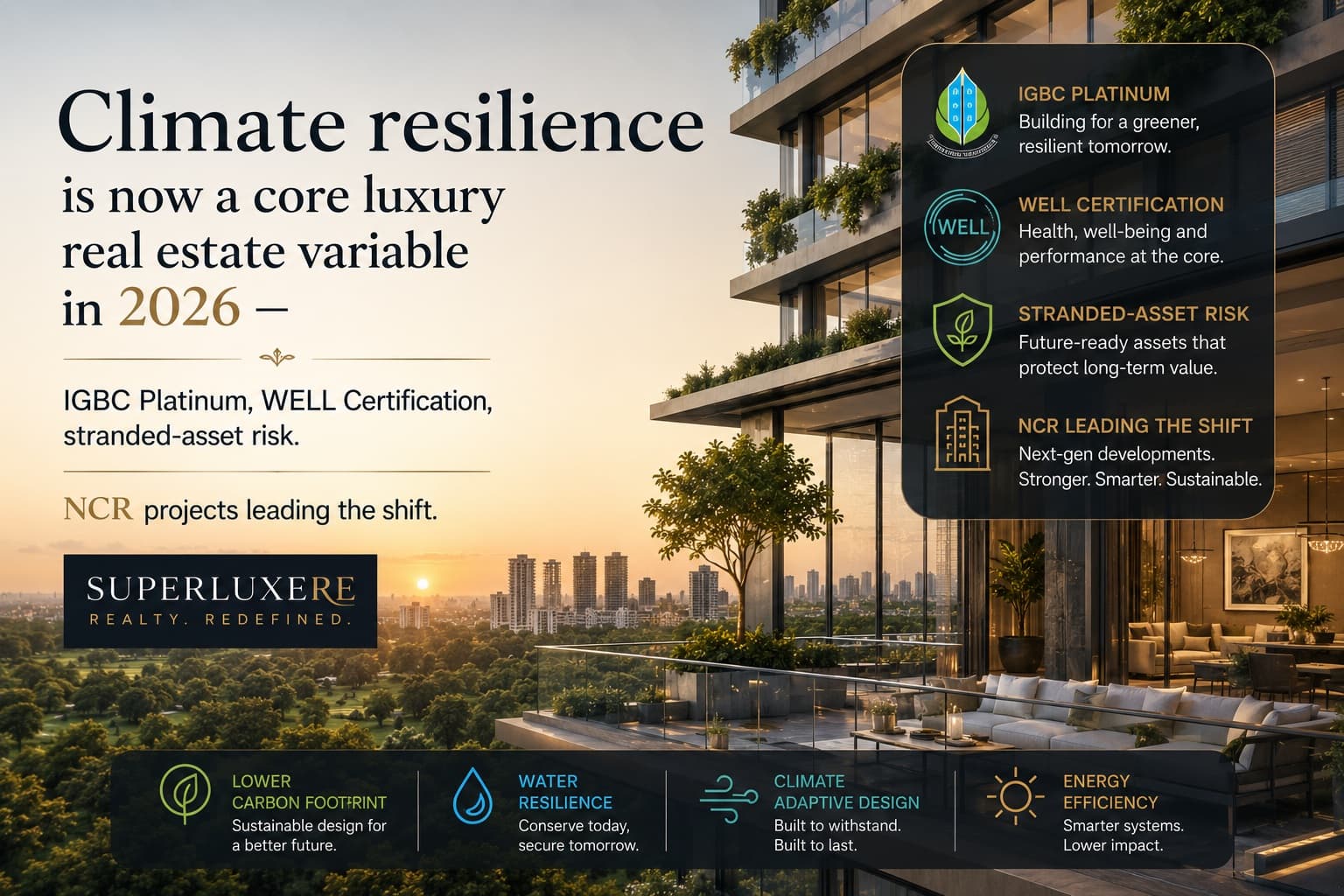
Climate resilience has shifted from a marketing line to a core valuation variable in Indian luxury real estate. IGBC Platinum, WELL Certification, flood-zone resilience, and energy autonomy are now the specifications that separate premium new builds from stranded-asset risk. What this means for NCR buyers in 2026.

Written by
Himanshu Bamola
Founder & Principal Analyst, SuperLuxeRE · 16+ years in ultra-luxury real estate strategy
Himanshu advises HNIs, NRIs, and family offices on India's most complex luxury real estate decisions — from Golf Course Road to Worli. His market analysis is trusted by buyers across Singapore, Dubai, London, and the US.
The Climate Variable
Why Climate Resilience Has Become a Core Luxury Real Estate Valuation Variable in 2026
Climate resilience has moved from a marketing tagline to a core valuation variable in Indian luxury real estate. World Environment Day 2026 marks the threshold at which buyers — particularly UHNW, family office, and NRI buyers — now scrutinise projects for flood-zone exposure, energy autonomy, IGBC Platinum and WELL Certification status, and climate-adapted infrastructure before evaluating amenities or location. The concept of "stranded assets" — properties losing value because they cannot adapt to climate change — is becoming an active investment-thesis variable. India's certified green building footprint has crossed 16.05 billion sq ft across 19,715+ IGBC-registered projects. For NCR luxury buyers in 2026, the question is no longer "is this building green?" but "does this building protect against climate-driven asset stranding?"
For two decades, sustainability in Indian real estate was treated as a nice-to-have — a checkbox in the marketing brochure that lifted the project's narrative without materially changing buyer behaviour. That has now structurally changed. The 2026 luxury buyer asks about flood zones, cooling costs, grid independence, and certification status before they care too much about square footage.
SuperLuxeRE Analysis: Climate risk has structurally entered the Indian luxury buyer's underwriting framework. Properties without resilience features are starting to feel like stranded assets — a term increasingly used by institutional investors managing real-asset portfolios. For super luxury NCR buyers, the implication is sharp: IGBC Platinum, WELL Certification, energy autonomy, and flood-zone protection have moved from "value-add" to "valuation floor." Projects without them face structurally higher risk of underperforming over a 10–20 year hold. Projects with them — Experion One42's WELL Certification, Godrej Samaris and Oberoi Three Sixty North's IGBC Platinum, the Max Estates LiveWell DNA — are positioned to compound, not stagnate, through India's climate transition.
Related Reading
📖 Go Deeper
The Stranded-Asset Risk — Why Climate-Unprepared Luxury Projects Are Becoming a Distinct Risk Category
The term "stranded asset" originated in fossil-fuel investment analysis — describing assets that lose value because the world transitions away from them faster than the asset can recover its capital cost. The concept has now arrived in Indian luxury real estate. A residential project built in 2018 without flood-zone resilience, without rooftop solar provisioning, without IGBC certification, and without adequate thermal performance specifications is structurally more exposed to:
- Rising operating costs — non-green buildings face higher air-conditioning load, higher water bills, higher common-area electricity, all of which compound annually
- Climate-driven physical risk — coastal flooding, urban heat island effects, water scarcity, and grid instability disproportionately affect older specifications
- Resale discount — green-certified properties show ~10–12% higher resale value; the converse is a 10–12% discount for non-certified comparable assets
- Insurance pricing — climate-exposed assets face higher property insurance premiums, increasingly priced into ownership economics
- Regulatory headwind — building codes are tightening; non-compliant existing buildings face costly retrofits or use restrictions
- Institutional capital exclusion — REITs, pension funds, and family offices increasingly screen out climate-exposed assets from acquisition pipelines
IGBC Platinum and WELL Certification — The Climate-Resilience Specifications That Now Define NCR Luxury
India's institutional luxury developer cohort has structurally shifted toward third-party-verified climate and health certifications. Two standards now dominate the NCR luxury specification stack.
- IGBC Platinum — administered by the Indian Green Building Council (founding member of WorldGBC) · evaluates energy efficiency, water conservation, indoor air quality, low-VOC materials, waste management · adopted by Oberoi Three Sixty North, Godrej Samaris, Max Estate 128, and many premium 2026 launches
- WELL Certification — administered by the International WELL Building Institute · evaluates human health impact across air, water, light, thermal comfort, sound, materials, mental wellbeing · adopted by Experion One42 · still structurally rare in Indian residential, signalling apex-tier global parity
- GRIHA Rating — India's national green building standard · adopted in several Max Estates and Godrej projects
- LEED Certification — global standard administered by US Green Building Council · used selectively in NCR commercial luxury and some hospitality-grade residences
The specifications matter operationally. IGBC Platinum buildings deliver 25–35% lower common-area electricity, verified ventilation and VOC standards, and documented thermal performance. WELL Certification adds an additional layer of human-health programming — air quality monitoring, water filtration, lighting design that supports circadian rhythm, acoustic management.
NCR Luxury Projects Leading on Climate Resilience in 2026 — The Specification Comparison
| Project | Certification | Climate Feature |
|---|---|---|
| Experion One42 (GCR Sector 42) | WELL Certified | 21-yr seepage guarantee · international façade |
| Oberoi Three Sixty North (GCER Sector 58) | IGBC Platinum | Sun-tracking sliding shades · thermal performance engineered |
| Godrej Samaris (GCR Sector 53) | IGBC Platinum | 4.5-acre Cooper Hills central green · 64% green cover |
| Max Estate 128 (Noida Sector 128) | IGBC Platinum Pre-Certified | LiveWell · real-time PM2.5/PM10 air purification |
| Max Estate 105 (Noida Sector 105) | LiveWell DNA | UV-filtered water · fresh treated air · biophilic design |
| The Terraces at Estate 361 (DXP Sector 36A) | LiveWell · IGBC anchored | 80,000 sq ft forest greens · sensory wellness programming |
The Climate Resilience Checklist — What NCR Buyers Should Verify Before Booking in 2026
✓ Buy If Verified
- IGBC Platinum or higher certification
- WELL Certification for human-health parity
- Flood-zone risk assessment available
- Rainwater harvesting & water-recycling systems
- Rooftop solar provisioning or installed
- Indoor air quality monitoring in-apartment
⚠ Caution If Missing
- No green certification at any tier
- Pre-2015 construction with no retrofit plan
- Coastal flood-zone or urban-heat-island risk
- Single-source grid dependency · no backup autonomy
- No documented water-stress contingency planning
- Glass façades without thermal performance specifications
Frequently Asked Questions
Why is climate resilience a luxury real estate variable in 2026?
Climate risk has structurally entered institutional real estate underwriting frameworks. Properties without resilience features face stranded-asset risk — losing value due to climate-driven operational costs, physical risk, regulatory tightening, and institutional capital exclusion. IGBC-certified properties show 15–20% lower maintenance costs and 10–12% higher resale value compared to non-certified comparable assets, making climate specifications a measurable economic variable, not a marketing line.
What is IGBC Platinum certification and which NCR luxury projects have it?
IGBC Platinum is India's highest green building certification, administered by the Indian Green Building Council. It evaluates energy efficiency, water conservation, indoor air quality, low-VOC materials, and waste management. NCR luxury projects with IGBC Platinum positioning include Oberoi Three Sixty North Sector 58, Godrej Samaris Sector 53, Max Estate 128 Sector 128 (pre-certified), Experion One42 (also WELL Certified), and several premium 2026 launches.
What is WELL Certification and how is it different from IGBC?
WELL Certification, administered by the International WELL Building Institute, evaluates a building's impact on human health across air quality, water, light, thermal comfort, sound, materials, and mental wellbeing. IGBC focuses on environmental sustainability (energy, water, materials), while WELL focuses on human health outcomes. They are complementary standards. In NCR, Experion One42 holds WELL Certification — making it one of the few residential projects in NCR with global health-standard parity equivalent to apex residences in Singapore, London, and New York.
How do green-certified buildings affect maintenance costs and resale value?
Certified green buildings in major Indian cities show approximately 15–20% lower maintenance costs (through reduced common-area electricity, water bills, and operational expenses) and approximately 10–12% higher resale value compared to non-certified comparable assets. Energy-efficient homes with solar rooftops, rainwater harvesting, and waste segregation systems also move faster in resale markets and command rental premiums of 8–10% post-retrofitting.
Should I retrofit my existing NCR property for climate resilience?
Yes, where economically viable. Smart retrofits — double-glazed windows, cool roofs, sensor lighting, composting units, water recycling, rooftop solar — can deliver value within 2–3 years on energy bill savings alone. For NCR existing-property owners, the question is no longer whether to retrofit but which interventions deliver highest IRR per rupee. SuperLuxeRE coordinates retrofit-feasibility assessments for qualifying assets.
Which NCR luxury project is the best climate-resilient buy in 2026?
For combined IGBC + WELL standards, Experion One42 on Golf Course Road Sector 42 leads — WELL Certified, 21-year seepage guarantee, international façade engineered for 25-year thermal performance, at ~₹45,000 psf. For IGBC Platinum at scale, Oberoi Three Sixty North (Sector 58 GCER, RERA mid-June 2026) and Godrej Samaris (Sector 53 GCR) lead. For Noida wellness anchoring, Max Estate 128 (resale) and Max Estate 105 (new launch) lead with LiveWell DNA. The right choice depends on possession horizon, ticket size, and city preference.
World Environment Day 2026 marks the threshold at which climate resilience structurally entered the Indian luxury buyer's underwriting framework. The stranded-asset concept — properties losing value because they cannot adapt — has arrived in residential real estate, and the buyers who understand this are now screening projects through certification status, energy autonomy, flood-zone exposure, and thermal performance before they consider amenities or location. For NCR buyers, the institutional luxury portfolio is already adapting — Experion One42's WELL Certification, Oberoi Three Sixty North and Godrej Samaris on IGBC Platinum, Max Estates' LiveWell DNA across the Estate 105, 128, 360, 361 portfolio. The wrong question in 2026 is "is this project green enough?" The right question is "will this project still command its premium in 2036, when climate risk is fully priced into Indian residential?" The certified luxury portfolio will. The uncertified portfolio will not.
Build a Climate-Resilient NCR Luxury Portfolio — Speak to SuperLuxeRE
SuperLuxeRE coordinates allocation across NCR's institutional luxury portfolio with full climate-certification screening — IGBC Platinum, WELL, GRIHA, LEED — for UHNW domestic buyers, family offices, and NRIs across five continents.
📞 +91-9873336686 | 📧 aspire@superluxere.com | 🌐 superluxere.com
Sources: Indian Green Building Council | International WELL Building Institute | GRIHA Council | World Green Building Council | SuperLuxeRE Research 2026.
Published by SuperLuxeRE
📞 +91-9873336686 | 📧 aspire@superluxere.com | 🌐 superluxere.com
Tagged: