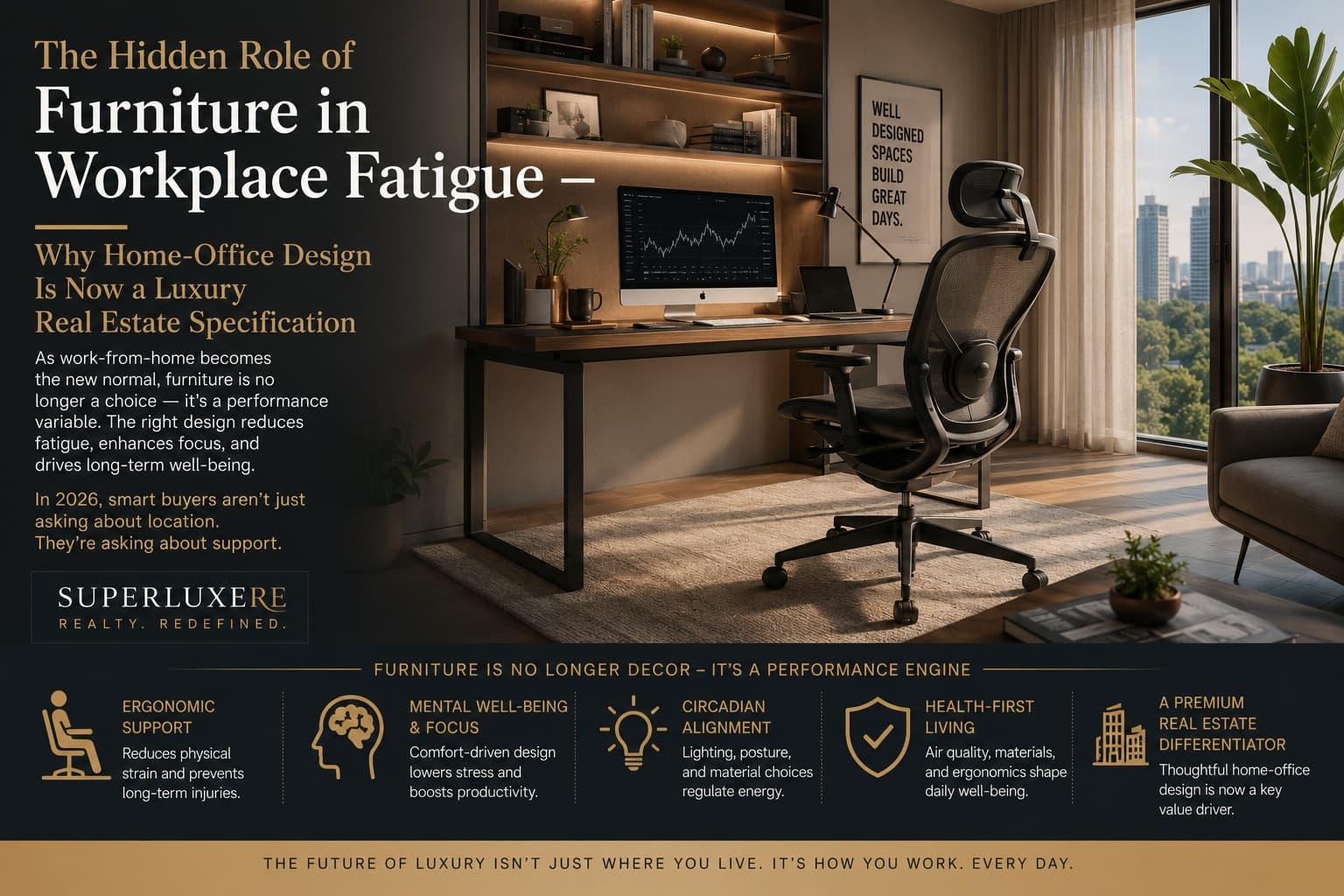
Workplace ergonomics research shows poor furniture and posture contribute to 65% of musculoskeletal issues — and 44–52% of remote workers report lower back pain. As hybrid work becomes structural, luxury residential is engineering home-office space into its specification stack.

Written by
Himanshu Bamola
Founder & Principal Analyst, SuperLuxeRE · 16+ years in ultra-luxury real estate strategy
Himanshu advises HNIs, NRIs, and family offices on India's most complex luxury real estate decisions — from Golf Course Road to Worli. His market analysis is trusted by buyers across Singapore, Dubai, London, and the US.
The Hidden Variable
Why Furniture, Ergonomics, and Home-Office Specifications Are Now a Luxury Real Estate Variable in 2026
Workplace ergonomics research now shows that poor posture and prolonged sitting contribute to 65% of musculoskeletal issues in office workers (Cornell University Ergonomics). For remote workers, 44–52% report chronic lower back pain, 25–35% report wrist and shoulder strain, and the "couch and coffee table" microtrauma crisis has emerged as a measurable productivity and health cost. As hybrid work has become structural — not transitional — Indian luxury residential is engineering dedicated home-office space, ergonomic infrastructure, and wellness-anchored specifications into its product stack. For UHNW, family-office, and NRI buyers evaluating NCR luxury in 2026, the question is no longer "does this apartment have a study room?" but "is this residence engineered for the way I actually work and live in 2026?"
The hidden role of furniture in workplace fatigue is not just an HR concern. It is now a residential specification concern — because the majority of UHNW knowledge workers, family-office principals, and NRI professionals spend more time working from their residence than at any time in modern history. The luxury apartment that did not anticipate this is showing its limitations.
SuperLuxeRE Analysis: Hybrid work has structurally changed what UHNW buyers need from their residence. The home is now both home and primary workplace for a large share of the day. The architectural and specification implications run deep — dedicated study rooms, natural lighting that supports circadian rhythm, acoustic separation between work and family zones, electrical and data infrastructure for serious office setups, and the kind of dimensional volume (high ceilings, wide decks) that supports cognitive recovery between work sessions. The super luxury projects engineered for this — Experion One42's WELL Certification (which evaluates circadian lighting, thermal comfort, acoustics), Max Estates' LiveWell DNA across Estate 105, 128, and The Terraces, the dimensional generosity of Kreeva New Friends Colony's double-height living-dining — are positioned to serve the way 2026 UHNW buyers actually work and live. Those that aren't engineered for this are slowly aging out of relevance.
Related Reading
📖 Go Deeper
The Ergonomics Research — What Workplace Health Studies Reveal About Furniture and Fatigue
Workplace ergonomics research conducted across UK, US, Hong Kong, Japan, and South Africa populations between 2020 and 2026 reveals consistent patterns. Poor furniture configurations and prolonged sitting drive measurable health and productivity outcomes that compound over months.
- Lower back pain — affects 44–52% of remote workers · most common complaint · typically caused by chairs lacking adequate lumbar support or positions that flatten the spine's natural curve
- Neck and upper back strain — affects 35–45% of knowledge workers · driven by monitor height mismatch and forward head posture
- Wrist, elbow, and forearm pain — 25–35% of remote workers · improper armrest height forces sustained shoulder muscle contraction · repetitive strain over months
- Static muscle fatigue — the broader category that emerges from staying in one position for hours · prevented by the 30/30 rule (30 seconds of movement every 30 minutes)
- The "couch and coffee table" microtrauma crisis — workplace ergonomics safety literature now identifies the home-office sofa as a primary source of cumulative spinal injury for hybrid workers
- Cognitive impact — physical discomfort distracts from focus · employees who feel physically comfortable are less likely to experience cognitive distraction from back pain, neck strain, or poor posture
Why Hybrid Work Has Made Home Office a Luxury Real Estate Specification
Pre-2020, the home office was a feature for a small minority of buyers — entrepreneurs, consultants, executives who occasionally worked from home. Post-2020, hybrid work has become the default knowledge-worker arrangement. The implications for what a serious luxury residence must deliver are structural.
- Dedicated study or office room — separate from bedrooms, with door for acoustic privacy, sized to accommodate full ergonomic furniture setup (sit-stand desk, ergonomic chair, secondary monitor)
- Natural lighting alignment — work zones positioned to receive natural light from the side, not directly behind monitors (which causes screen glare and pupil strain)
- Electrical and data infrastructure — adequate power points positioned for desk setups, structured cabling for high-bandwidth internet, UPS backup provisioning
- Acoustic separation — work zones acoustically isolated from family/living spaces · meaningful for video conferences, focused work, and household members in different work cycles
- Circadian-supporting design — colour temperature variation across the day, natural light penetration, view to outdoor green that supports cognitive recovery
- Movement-encouraging layout — dimensional generosity that makes the 30/30 rule practical · wide decks for stretching, corridors for walking, balconies for stand-up breaks
- Wellness amenity proximity — clubhouse gym, yoga studio, walking trails accessible without elevator-and-car logistics that defeat the daily-use case
How NCR Luxury Projects Are Engineering Home-Office and Wellness-First Specifications in 2026
| Project | Format | Wellness & Home-Office Anchor |
|---|---|---|
| Experion One42 | 6,200 / 8,300 sq ft | WELL Certified · circadian lighting · air quality · 8-12 ft decks for movement breaks |
| Max Estate 105 | 3,754 - 7,000 sq ft | Walk Well philosophy · 3.6m ceilings · UV-filtered water · biophilic design · elevated skywalk |
| Max Estate 128 | 4,400 - 5,200 sq ft | LiveWell · real-time PM2.5/PM10 air purification · 3.75m wraparound decks · 11ft internal ceilings |
| The Terraces at Estate 361 | 1,144 - 1,687 sq ft | Sensory wellness programming · 80,000 sq ft forest greens · Antara Care at Home |
| Oberoi Three Sixty North | 5,500 / 8,500 sq ft | IGBC Platinum · triple-height lobbies · 8-12 ft decks · sun-tracking sliding shades |
| Kreeva New Friends Colony | 3,500 / 4,500 / 5,000 sq ft | One unit per floor · private lift lobby · double-height living-dining · acoustic privacy structural |
The Home-Office Specification Checklist — What UHNW Buyers Should Verify in 2026
✓ Look For
- Dedicated study/office room (not bedroom-converted)
- Natural light from side, not behind monitor zone
- WELL Certification or LiveWell wellness anchoring
- High ceilings (11+ ft) for dimensional cognitive recovery
- Wide decks for stretch and stand-up breaks
- In-apartment air quality monitoring · circadian lighting
⚠ Avoid
- 9-10 ft standard ceilings · no dimensional volume
- No dedicated work zone separate from bedroom
- North-facing work zones with no natural light
- No clubhouse gym or yoga within building envelope
- Inadequate power/data infrastructure for office setup
- No acoustic separation between work and living zones
Frequently Asked Questions
How does furniture and home-office design affect health and productivity in 2026?
Cornell University Ergonomics research shows poor posture and prolonged sitting contribute to 65% of musculoskeletal disorders in office workers. International workplace health studies covering UK, US, Hong Kong, Japan, and South Africa populations show 44–52% of remote workers report chronic lower back pain, 25–35% report wrist and shoulder strain. As hybrid work has become structural, the home environment now drives a meaningful share of cumulative health and productivity outcomes — making home-office specification a measurable variable.
Why is home-office design now a luxury real estate specification variable?
Pre-pandemic, the home office served a small minority of buyers. Post-pandemic, hybrid work is the default knowledge-worker arrangement for UHNW, family-office, and NRI professionals. The luxury apartment must now deliver dedicated work zones, ergonomic-supporting dimensional volume (high ceilings, wide decks), natural lighting alignment, electrical and data infrastructure, acoustic separation, circadian-supporting design, and movement-encouraging layout. Projects that engineered this into their specification — Experion One42 (WELL Certified), Max Estate 105 (Walk Well), Max Estate 128 (LiveWell with air purification), Oberoi Three Sixty North (IGBC Platinum) — are positioned for 2026 buyer requirements. Projects that didn't are not.
What is the 30/30 rule and how should luxury residential design support it?
The 30/30 rule is a workplace ergonomics behavioural habit — 30 seconds of movement every 30 minutes — that prevents static muscle fatigue, resets the spine, and is highly effective at preventing long-term musculoskeletal disorders. For luxury residential, supporting the 30/30 rule means dimensional generosity in design: wide decks for stretching, corridors for short walks, balconies for stand-up breaks, clubhouse amenities accessible without elevator-and-car logistics that defeat daily use. Projects with 8–12 ft decks, 11+ ft ceilings, and well-integrated wellness amenities make the 30/30 habit practical rather than aspirational.
Which NCR luxury projects are best engineered for hybrid work in 2026?
Five projects lead on home-office and wellness specifications. Experion One42 (WELL Certified · 6,200 and 8,300 sq ft · 8-12 ft decks · circadian lighting). Max Estate 105 (Walk Well · 3.6m ceilings · Noida's first elevated skywalk · biophilic design). Max Estate 128 (LiveWell · real-time air purification · 3.75m wraparound decks). Oberoi Three Sixty North (IGBC Platinum · triple-height lobbies · sun-tracking shades). Kreeva New Friends Colony (one unit per floor · acoustic privacy structural · double-height living-dining). The right fit depends on city preference, ticket size, and possession horizon.
What is WELL Certification and why does it matter for hybrid workers?
WELL Certification, administered by the International WELL Building Institute, evaluates a building's impact on human health across air quality, water, light, thermal comfort, sound, materials, and mental wellbeing. For hybrid workers spending 6-10 hours daily in their residence, every variable in the WELL framework directly impacts daily fatigue, focus, and long-term health. Experion One42 holds WELL Certification — making it the NCR luxury project with the deepest engineered alignment to hybrid-work residential requirements.
How should I configure my home office in a luxury residence to reduce workplace fatigue?
Six principles. Position the desk perpendicular to a window (natural light from the side, not behind). Use an ergonomic chair with adjustable lumbar support and seat depth. Monitor at eye level (top of screen at brow line). Sit-stand desk with 1-2 transitions per day. Keep work zone separate from sleep zone (different rooms, ideally). Apply the 30/30 rule rigorously. Within a luxury residence with high ceilings, wide decks, and dimensional generosity, supporting these habits becomes structural rather than aspirational. SuperLuxeRE coordinates designer introductions for buyers commissioning interiors in line with international ergonomic best practice.
The hidden role of furniture in workplace fatigue is not a back-office HR concern — it is a residential specification concern. As hybrid work has become structural, the apartment is now both home and primary workplace. The specifications that matter — dedicated work zones, dimensional volume, natural light alignment, WELL or LiveWell wellness anchoring, acoustic separation, wide decks for movement, in-apartment air quality — are the ones that separate residences engineered for 2026 from residences that froze at pre-2020 assumptions. The NCR luxury projects leading on this — Experion One42's WELL Certification, Max Estates' Walk Well and LiveWell DNA across Estate 105, 128, and The Terraces, Oberoi Three Sixty North's IGBC Platinum and triple-height lobbies, Kreeva's dimensional generosity at New Friends Colony — are not just selling apartments. They are selling residences engineered for the way knowledge workers actually live and work in 2026. For the serious buyer, this is no longer a peripheral specification. It is core.
Find a Home Engineered for the Way You Work — Speak to SuperLuxeRE
SuperLuxeRE coordinates allocation across NCR's institutional luxury portfolio with full wellness-and-work-engineering screening — WELL, IGBC Platinum, LiveWell DNA — for UHNW domestic buyers, family offices, and NRIs across five continents.
📞 +91-9873336686 | 📧 aspire@superluxere.com | 🌐 superluxere.com
Sources: Cornell University Ergonomics | International WELL Building Institute | OSHA | Indian Green Building Council | SuperLuxeRE Research 2026.
Published by SuperLuxeRE
📞 +91-9873336686 | 📧 aspire@superluxere.com | 🌐 superluxere.com
Tagged: